
• Skip to primary navigation
  • Skip to main content
  • Skip to primary sidebar
  • Skip to footer

Manhattan Digest

All you need to know about Manhattan culture and so much more...

  • LIFESTYLE
  • ENTERTAINMENT
  • LGBT
  • OPINION
  • TECHNOLOGY

TECHNOLOGY

Gadgets: The Good, The Bad and the Coming Soon

by Alex David Jimenez

banner

We’re well on our way into 2014, and with each milestone we pass, the future becomes more, well, nerdy. Nerdy, that is, in the sense of existing on a more technology and algorithm-based plane. The planet around us is growing smaller as more and more of our OS and HTML obsessed brains grow just a little bit larger. The tech world grows faster every day, and it shows. The late 2013 is no exception to the rule, having given us many bright new gadgets, as well as many dull ones.

In a nutshell, here are the better, best, and not-so-good #gadgets of 2013, (as well as the rising stars to watch in 2014) including smart phones, tablets, laptops, gaming systems, wearable tech, apps, mobile operating systems, and other miscellaneous gadgets.


Smart Phones 2013

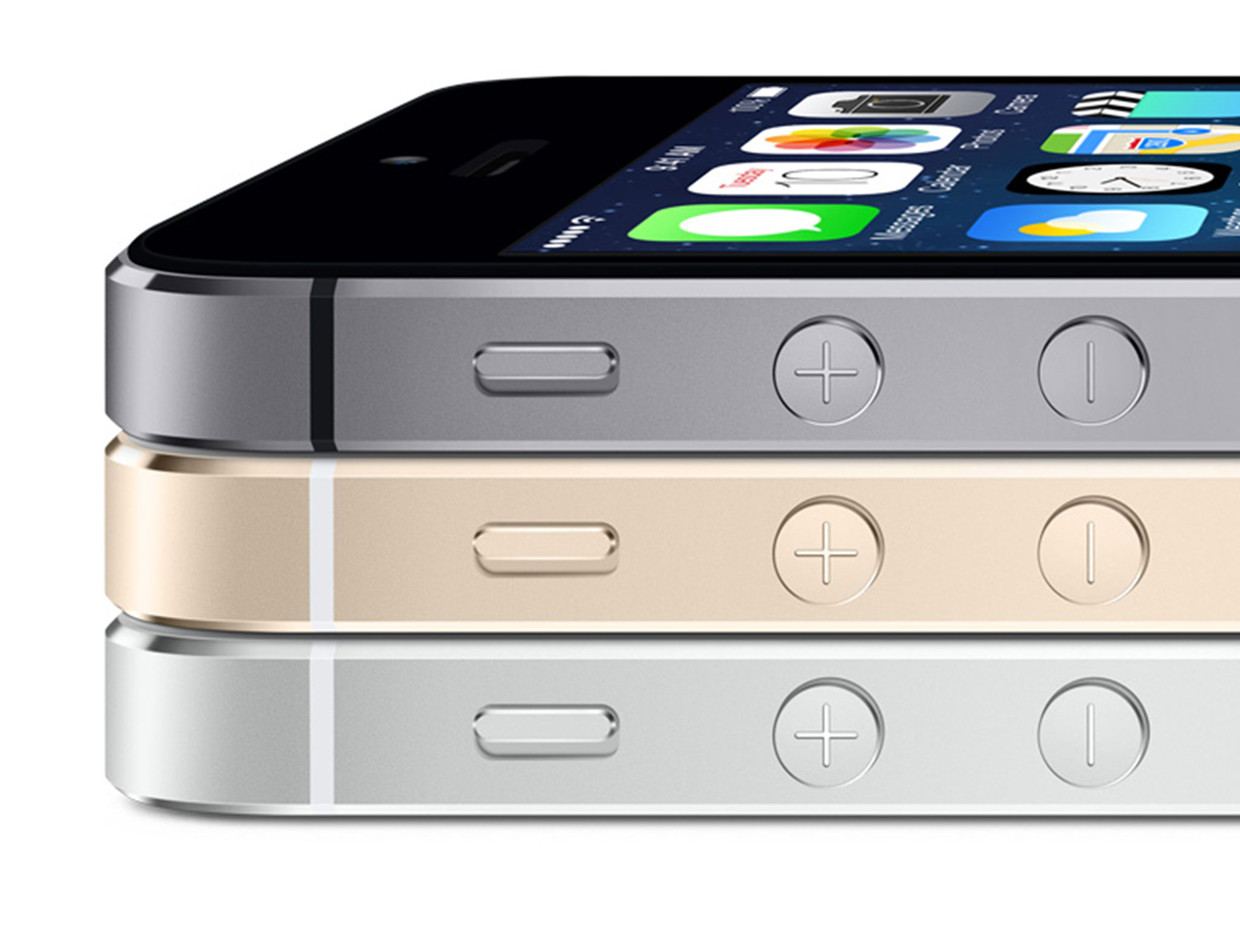
Winner: Apple iPhone 5s

Runner-up: HTC One

Loser: Blackberry Z10

The one to watch in 2014: Motorola Project ARA

gadgets
Graphic courtesy Alex Hillsberg – financesonline.com

Tablets 2013

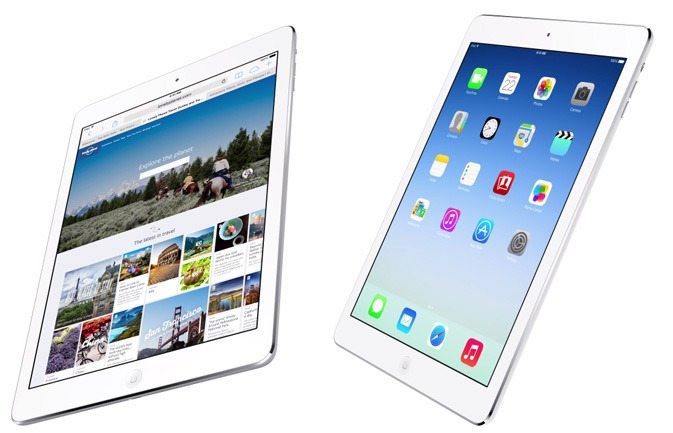
Winner: Apple iPad Air

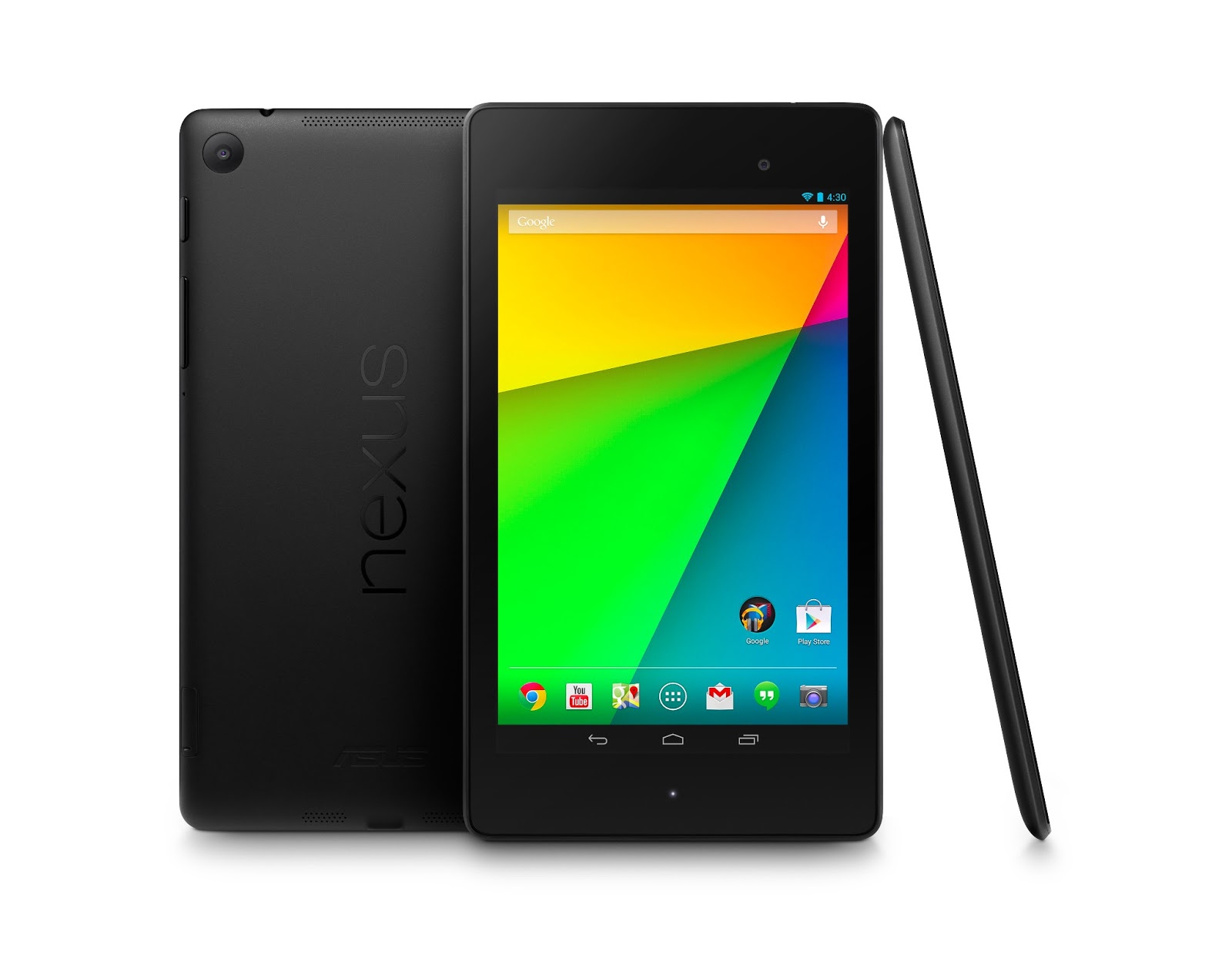
Runner-up: Google Nexus 7

Loser: Microsoft Surface RT

The one to watch in 2014: Amazon Kindle Fire HDX

Graphic courtesy Alex Hillsberg - financesonline.com
Graphic courtesy Alex Hillsberg – financesonline.com

Laptops 2013

Winner: Apple MacBook Air 13″

Runner-up: Samsung ATIV Book 9 Plus

Loser: Google Chromebook Pixel

The one to watch in 2014: Asus Taichi

Graphic courtesy Alex Hillsberg - financesonline.com
Graphic courtesy Alex Hillsberg – financesonline.com

Gaming Systems 2013

Winner: Sony Playstation 4

Runner-up: Microsoft XBox One

Loser: Ouya

The one to watch in 2014: Oculus Rift
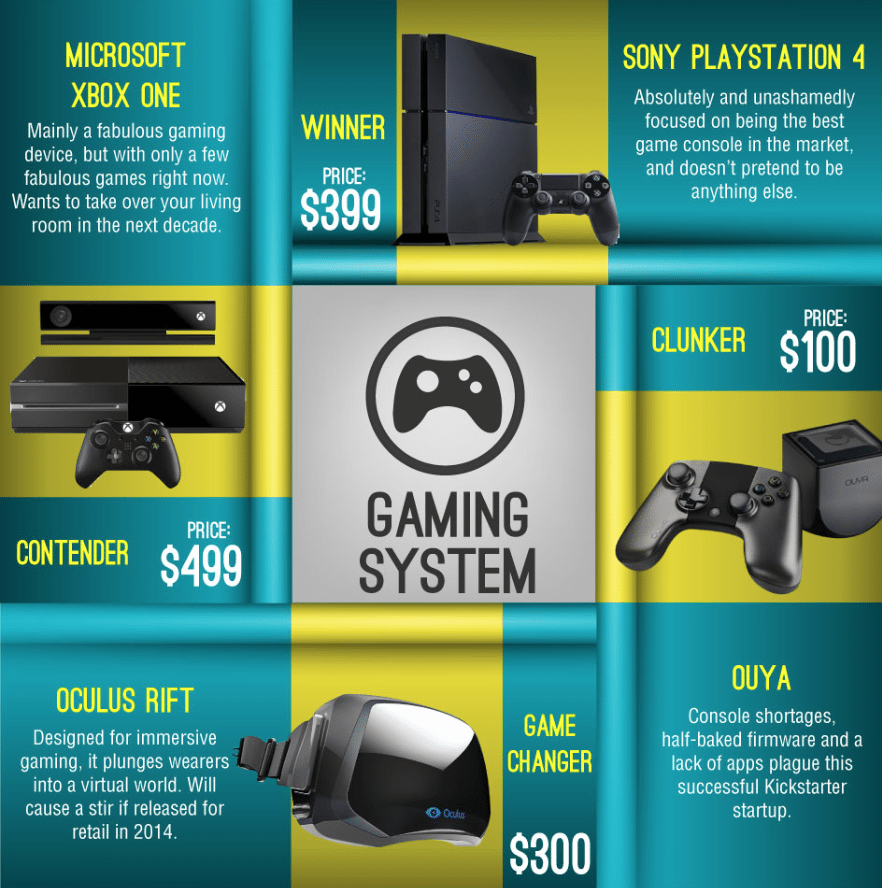
Graphic courtesy Alex Hillsberg – financesonline.com

Wearable Tech 2013

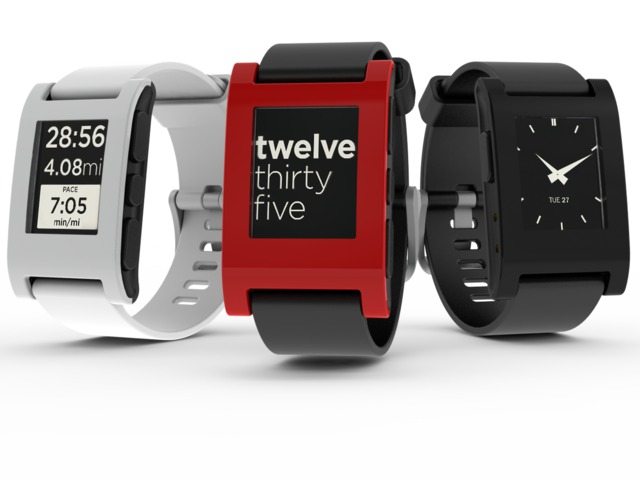
Winner: Pebble Smartwatch

Runner-up: Misfit Shine

Loser: Samsung Galaxy Gear

The one to watch in 2014: Google Glass
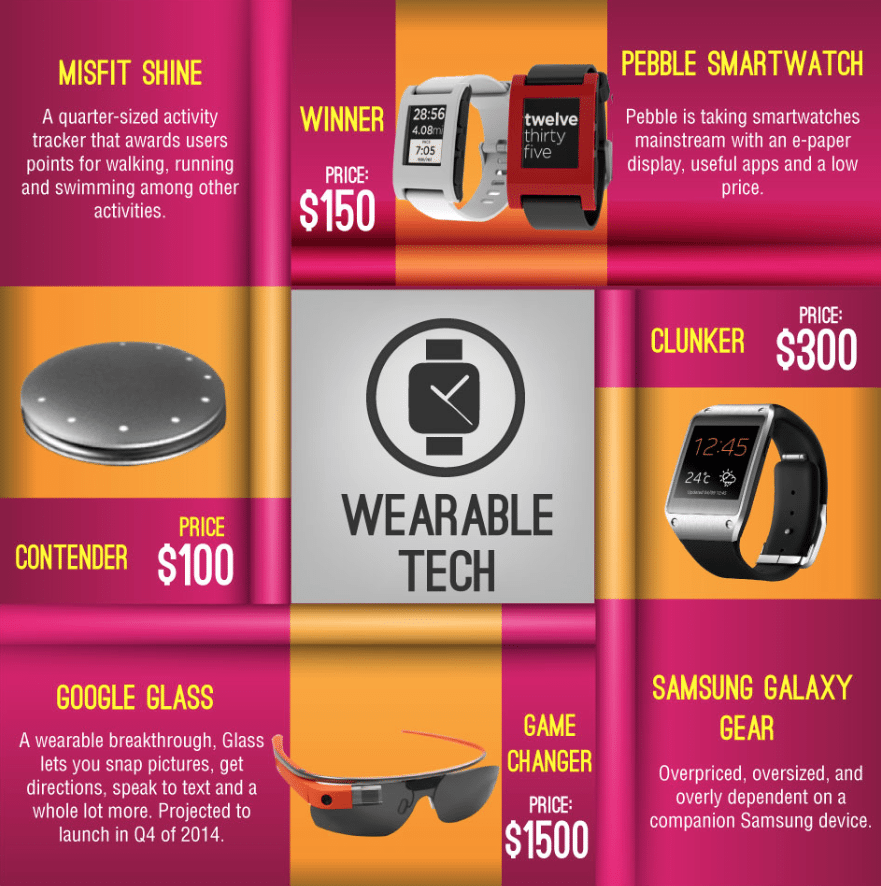
Graphic courtesy Alex Hillsberg – financesonline.com

Mobile Apps 2013

Winner: Waze

Runner-up: Blackberry Messenger

Loser: Twitter #Music

The one to watch in 2014: Tinder
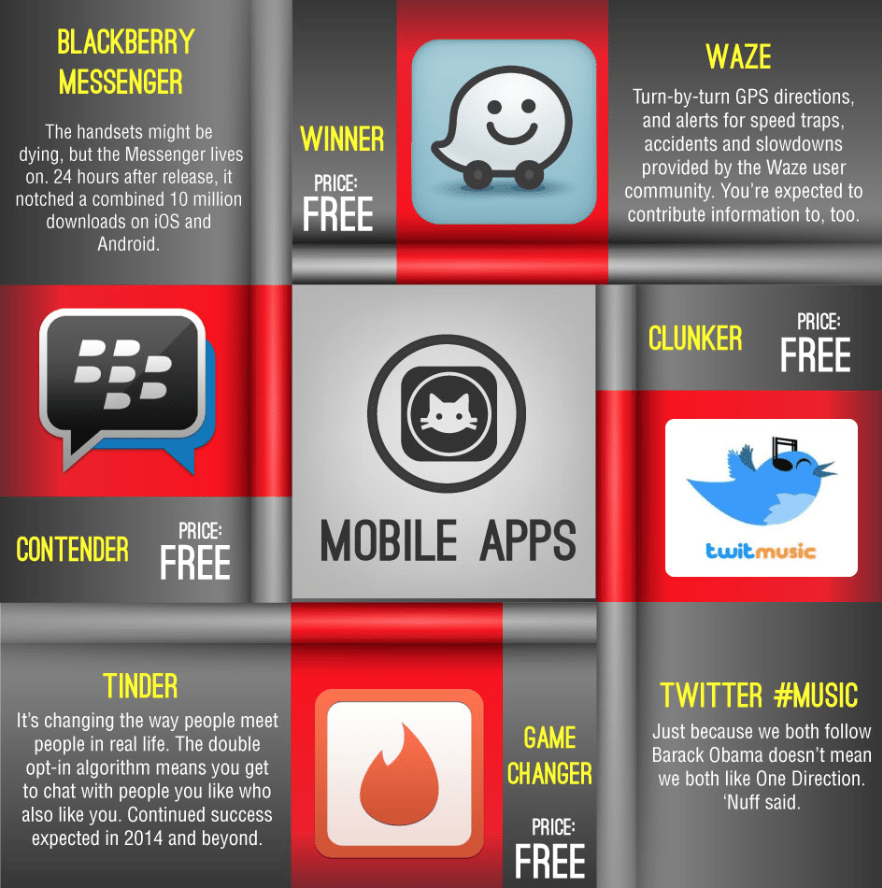
Graphic courtesy Alex Hillsberg – financesonline.com

Mobile OS 2013

Winner: Android 4.4 KitKat

Runner-up: Apple iOS 7

Loser: Blackberry BB10

The one to watch in 2014: UBUNTU
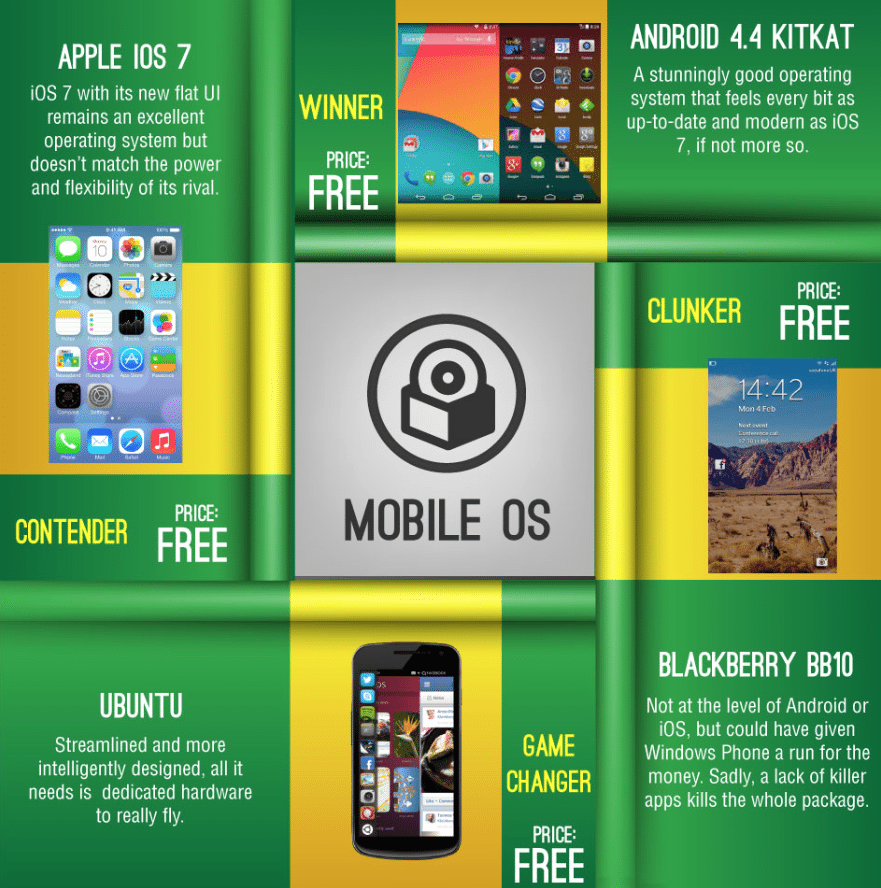
Graphic courtesy Alex Hillsberg – financesonline.com

Other Gadgets of 2013

Winner: Google Chromecast

Runner-up: NEST Project

Loser: Hapilabs Hapifork

The one to watch in 2014: Leap Motion
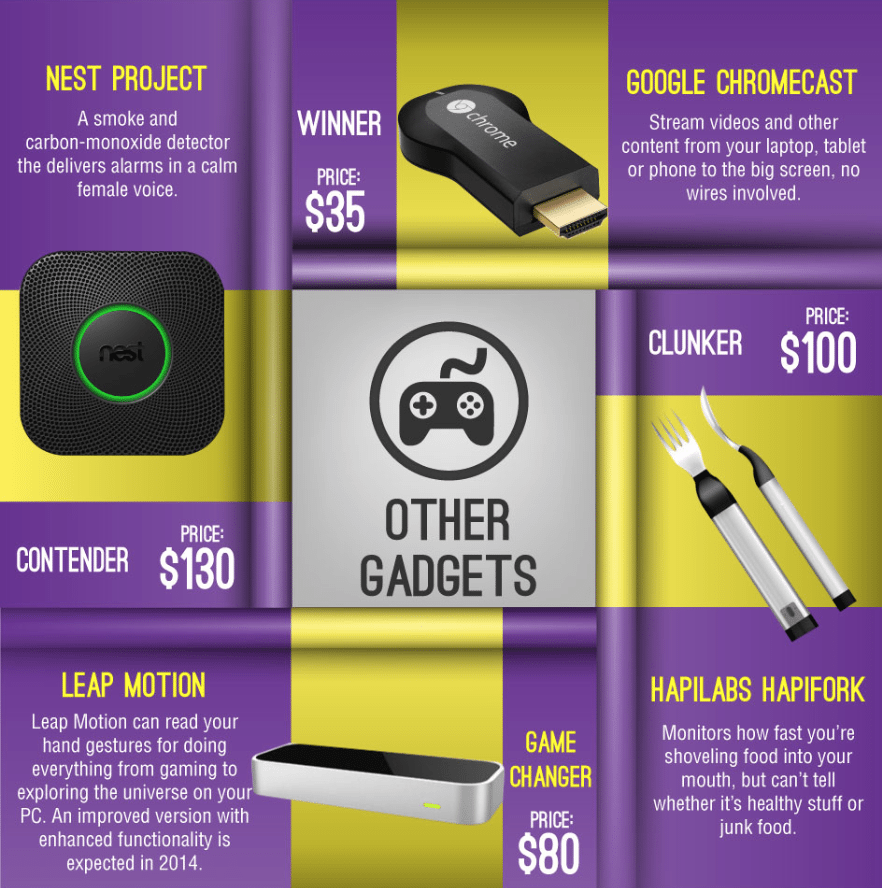
Graphic courtesy Alex Hillsberg – financesonline.com

All graphics are courtesy Finances Online and designed by Ruby Media Corporation


Filed Under: OPINION, TECHNOLOGY Tagged With: 2013, 2014, Apple, asus, best, Blackberry, chrome book, chrome cast, gadgets, Google, HTC, ios, Leap Motion, microspft, Nest, pebble, playstation, Samsung, tech, technology, Twitter, waze, worst, xbox

Top Five Games of 2013

by Tim Morris

Looking back at the best games of the year!

This year has been a highly eventful one in the world of gaming. We’ve seen multiple console releases in the PS4, XBOX One, and Nintendo’s handheld 2DS. Many of the most popular series received new installments, like Call of Duty, Assassin’s Creed, Grand Theft Auto, Pokemon, and much more. However, popular doesn’t necessarily mean good, and so this list looks different than most of the ones being put out. Please note that this is of course my opinion and as such I can only base the list on games that I’ve actually played. So without further ado, my top five games of 2013 (in no particular order):

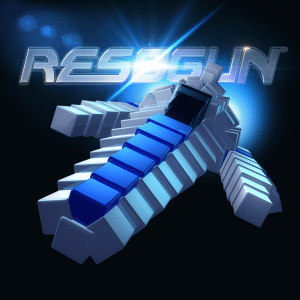
Resogun

Copyright Housemarque Source: 4playernetwork
Copyright Housemarque
Source: 4playernetwork

At the low price of free for PS+ members ($14.99 otherwise), Resogun is a wallet-friendly option for those who need a good value from their games. This old-school spaceship shooter delivers the nostalgic gunplay of Galaga on a cylindrical plane with sharp visuals and particle effects. Featuring five levels and three selectable ships, Resogun only seems thin on content; the sheer number of trophies that encourage multiple playstyles encourages deep replay value. Add in four difficulties and online co-op and you’ve got a complete package for a nominal fee. If your gaming history dates back to the early 1990s like mine does, you’d be doing yourself a disservice by not picking this game up.

Pokemon X/Y

Copyright Gamefreak Source: Junkiemonkeys
Copyright Gamefreak
Source: Junkiemonkeys

No list of the best games of 2013 would be complete without Pokemon X/Y. With more features than ever before, Gamefreak pulled out all the stops to revive a franchise that in the eyes of this writer had been flatlining for years. Wonder Trade leads the charge as the best new feature, allowing you to instantly trade with anyone in the world. Want more control over what you get? Fire up the Global Trade System and specify what you’re looking for. You can now play mini-games to “super train” your Pokemon, making them stronger even faster. Finally, if you just want to chill out and enjoy your Pokemon’s company, you can go into Pokemon-Amie to play with them and feed them. With the most immersive experience in the franchise’s history, Pokemon X/Y is sure to please new and old fans alike.

NHL 14

Copyright EA Source: EA Sports
Copyright EA
Source: EA Sports

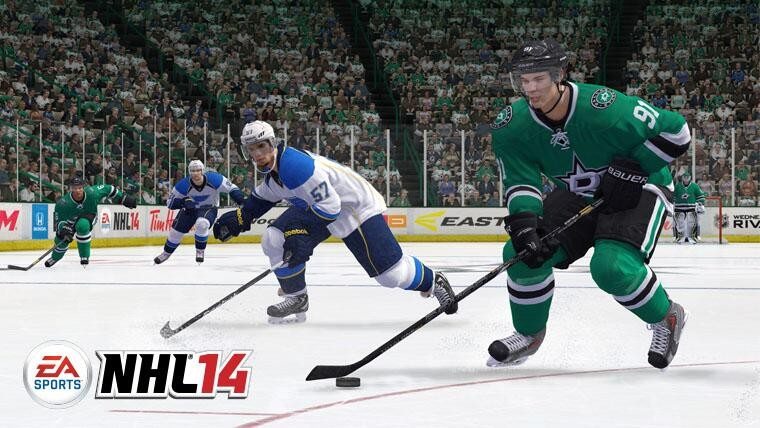
EA’s hockey franchise has been going strong for six seasons now, and this year it delivered big time on its new Live The Life mode. Upgrading the previous Be A Pro mode into something far more deep, Live The Life much more closely mimics the career of a hockey player than its predecessor. You can gain endorsements, answer a variety of interview questions, respond to any other situations that arise, and of course, play the game and impress the coach and brass for your team. On the actual gameplay side, NHL 14 delivers more customization and more goals. Scoring is way up in this game compared to year’s past, and while in some cases it’s too easy to find the back of the net, you can always adjust the settings to your liking. If you’re looking for a top-flight sports game, you can’t go wrong with NHL 14.

Super Mario 3D World

Copyright Nintendo Source: Gather Your Party
Copyright Nintendo
Source: Gather Your Party

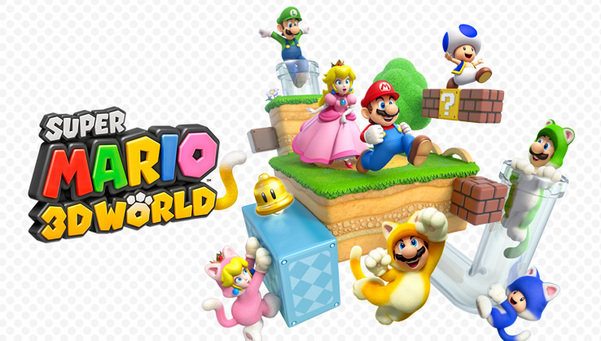
While the same formula in use since the release of New Super Mario Bros. may be getting tired to some, the concept and gameplay of Super Mario 3D World adds a new element of adventure to the series. Famous for continuing to reinvent the wheel with its own IPs, Nintendo once again delivers a fun party adventure game that is just as enjoyable when played solo. One of the most welcome changes to this new entry comes in the form of the playable lineup. Instead of having two generic Toads, there’s only one this time and the open slot is filled by none other than Princess Peach. While I’d still like to see a bit more variety in that respect (maybe add Wario, Waluigi, or perhaps even Yoshi as a gimmick character), Nintendo has asserted their platforming prowess and brought another Mario adventure to the homes of thousands.

Flower

Copyright ThatGameCompany Source: PixelEnemy
Copyright ThatGameCompany
Source: PixelEnemy

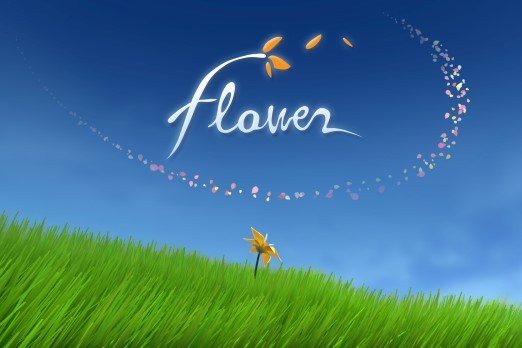
I conclude this list with a game that you might not expect. Flower is proof that video games are true works of art. The best way that I can describe Flower is that it’s the most soothing game I have ever experienced, and I’ve never found myself in a more peaceful state while playing a video game. The best part about the game is that you can spend hours in a single area without ever being told that you’re failing or that you should be doing something else. While you can clear each of Flower‘s levels by opening all of the flowers and turning the initially drab fields into lush, colorful landscapes, there’s no hurry to do so. You can simply fly around the level and enjoy the beautiful musical score if you like. If you own a PS4 (or even a PS3), you need to own Flower.

Filed Under: ARTS, ENTERTAINMENT, OPINION, TECHNOLOGY, uncategorized

Green Roofs and the Science of Sustainable Design

by Austin Arrington

Green roof
Green Roof
An Alive Structures green roof combining sedum mats with native plants.

Perfecting urban green roofs for their environmental and social benefits is a good example of where science and design meet.

The benefits of green roofs include insulation, reduced energy use, the removal of air pollutants and green house gases, increased roof lifespan, reduced heat stress, stormwater runoff management, beautification, and improved health.

There are two types of green roofs—extensive and intensive. Extensive green roofs have a soil depth of 1”- 5,” and are planted with sedums and short grasses. Intensive green roofs need at least one foot of soil and can be vegetated with trees, shrubs, and perennials.

Biology PhD candidate at York University in Toronto Scott McIvor has questioned the performance of sedum to absorb water and promote biodiversity, claiming that plants adapted to local conditions work better.

Sedum doesn’t absorb water as efficiently as some native species, while it is useful for lowering the building energy requirements of air-conditioning and heating.

Determining which green roofs plants best support biodiversity requires finding the right soil composition for microorganisms to live in. This is an ongoing question scientists are exploring.

Figuring out how to best integrate sedum with other plants, to maximize the potential benefits of a green roof, is where design comes in. Producing a green roof for rainwater run-off and climate management requires creative and efficient design.   

Alive Structures is a company of landscape designers and environmentalists based out of Brooklyn. They do residential, community, and educational green roof and garden projects across the five boroughs. Their green roofs often integrate locally grown sedum mats with native plants.

Part of what makes a particular landscape architecture piece interact well with its environment is its artistic quality—a design for beauty as well as function.

I learned this from a friend and gardener, who taught me that working with plants is an art, as much as working with musical notes, letters, or pictures.

The shape and placement of plants produces a wide array of feelings in us, and can contribute dynamically to how we interpret the city’s architecture.

Of course, as a green roof is a part of a whole building, it must also function in support of the people that work or live within that building. One of the most present benefits of green roofs to urban dwellers is the chance to interact outdoors with plants.  

Being outdoors and spending time around plants have both been shown to correlate with increased wellbeing, health, and social functioning. This makes sense, as the design function of humans is to actively interact with our environment. 

Rooftops play an important role in New York City’s culture and architecture. The conscious Manhattanite is aware of the city on multiple levels—horizontal, vertical, urbane and environmental. Plants are the city’s symbiotic allies—an extra set of lungs to help us breath and continue growing.

Imagine if at the office you could take five minutes to walk outside onto a small field basking in the sun. A space to think and develop a relationship with some part of nature.

The good news is that Bloomberg’s PlaNYC initiative offers a tax abatement to green roof property owners for up to $150,000.

Green roofs can contribute to LEED certification as well—by protecting or restoring habitats, maximizing open space, storm-water quality control, reducing the heat island effect, and increasing water efficiency.

Green roofs support biodiversity by providing a habitat for native plants, invertebrates, birds and other animals.

Green roof
A close-up of the plant diversity at a roof in the East Village.

Small-scale, local food production is also possible with green roofs—creating opportunities for urban communities to partake in healthy, in-season produce.

Green roofs do require maintenance, especially if you expect to grow food on them. But that’s sort of the point—taking time to slow down. If “getting lost” in nature sounds like a waste of time, you can look it as a chance to recharge your battery.  

Much of the health benefits of green roofs are rooted in aesthetics. Green roofs give us something beautiful to look at and meditate on. They also reduce noise pollution, which is a major contributor of urban stress.

Evidence shows that simply being around plants leads to lower blood pressure, increased attentiveness, productivity and job satisfaction, lower anxiety, and improved wellbeing. Green roofs can serve as collective spaces for individuals to cooperate and work in, while enjoying the beauty of nature together. 

The mental state induced by working with plants has deep evolutionary roots. Tending plants can help the mind form a conscious relationship of stewardship to the environment.

At some level, green roofs might be viewed as a built-in escape mechanism. For me, they are a welcome refuge from the stress, anxiety, and noise of the city.

There is no single or obvious solution to designing sustainable cities. Green roofs may work well in some places, but they are certainly not a fix-all for the environmental shift that we are now experiencing.

However, if designed well, green roofs can support biodiversity, reduce the energy use of buildings, and help mitigate the effects of climate change. Their design and implementation can positively influence how city dwellers interact with and are conscious of their environment.


Filed Under: ARTS, BREAKING NEWS, SCIENCE, STYLE, TECHNOLOGY, uncategorized Tagged With: design, green roof, manhattan digest, science, sustainability

Christmas Shopping: Final Weekend. Best Options.

by Alex David Jimenez

Christmas Shopping

And here we are: the final weekend of Christmas shopping. The last push to get everything on your never-ending list of perfect gifts for all those people you love, and those you are sort of obligated to love. In these final stressful hours of panic and claustrophobia galore, one thing always seems to elude us as consumers: bargain hunting. It’s always a game of looking for the best deals right after Thanksgiving, with Black Friday being the culmination of it all. Yet as December 25th approaches, we find ourselves more and more concerned with getting anything at all, rather than getting something for the best price. And while yes, the smiles and laughter and joy of everyone’s satisfied faces on Christmas morning are worth it, what sort of looming raincloud awaits your wallet once the festivities are over?

To help you out, here are seven simple substitutes to some of the hottest tech gifts of the season. Instead of buying that five-hundred dollar game console, why not opt for something half the price, and worth equal amounts of fun? Check out the alternatives, and don’t go broke during these last few shopping-frenzied days.


1.

HOT ITEM

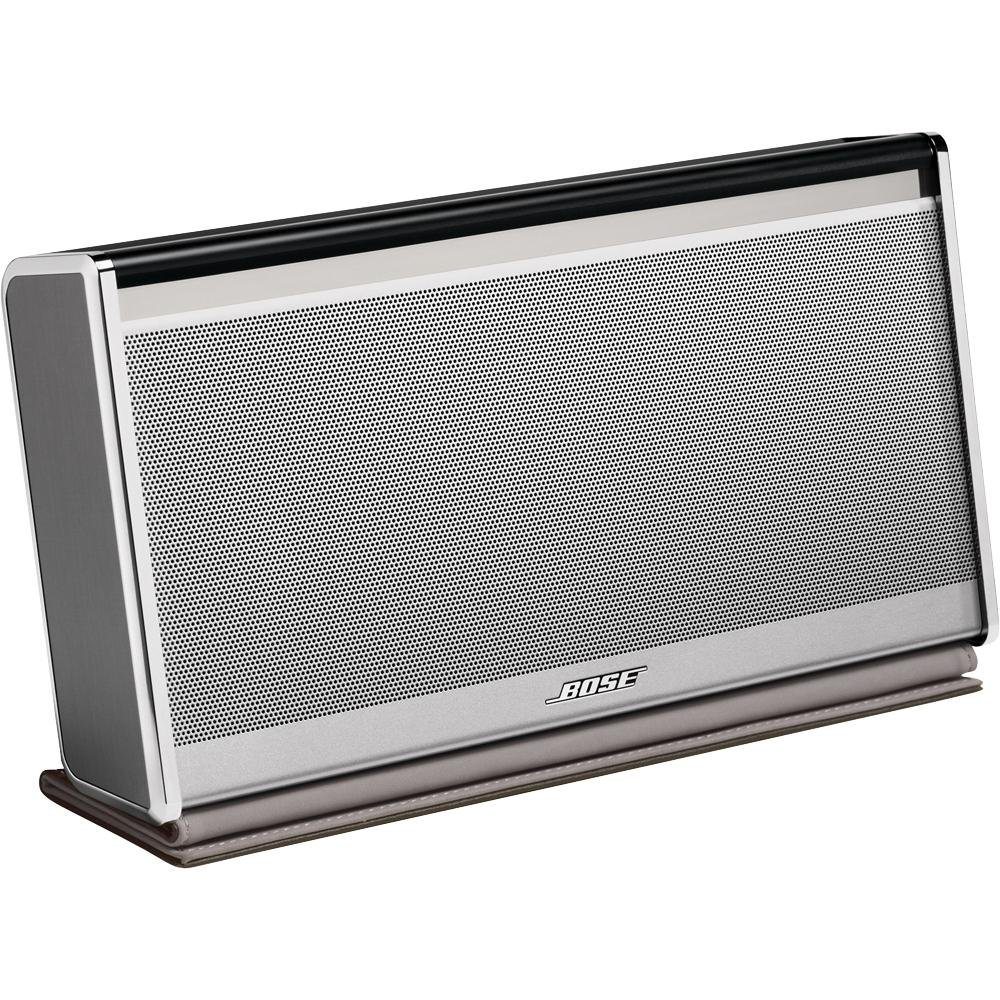
Bose Soundlink Bluetooth Mobile Speaker II — $314.95

Bose Soundlink

It’s no secret that BOSE is the leader in sound technology and quality. The Bluetooth speaker is quickly emerging as the new big thing in speaker production. Not only do you not need to plug in your music device, but now the common dock for sound devices isn’t even necessary. The music is wirelessly transmitted via bluetooth from your device to the speaker, and we don’t have to tell you that the sound quality is pristine.

While BOSE is the leader in sound, it can be a little pricey. This speaker comes in at $314.95.

Bose.com


THE ALTERNATIVE

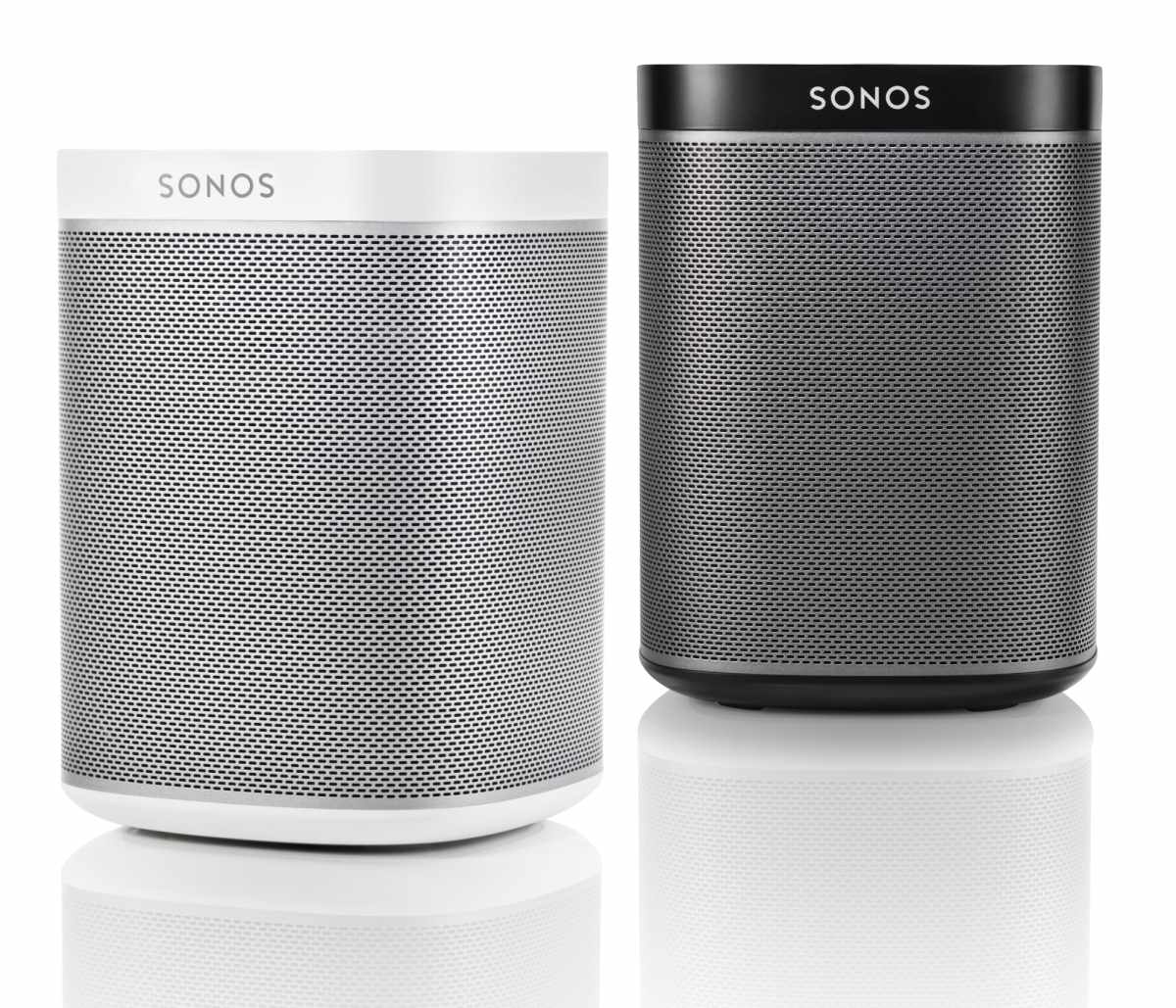
Sonos Play 1 — $199.00

sonos-play

The Sonos Play 1 is a newer item to the market, offering the same technology of wireless music connectivity for a lower price. While the device may not have the namesake, the quality is there. The Sonos Play delivers music without wires or docking, and can offer multiple speakers (with purchase) playing from the same music device all at once.

The Sonos Play 1 is available starting at $199.00.

sonos.com


2.

HOT ITEM

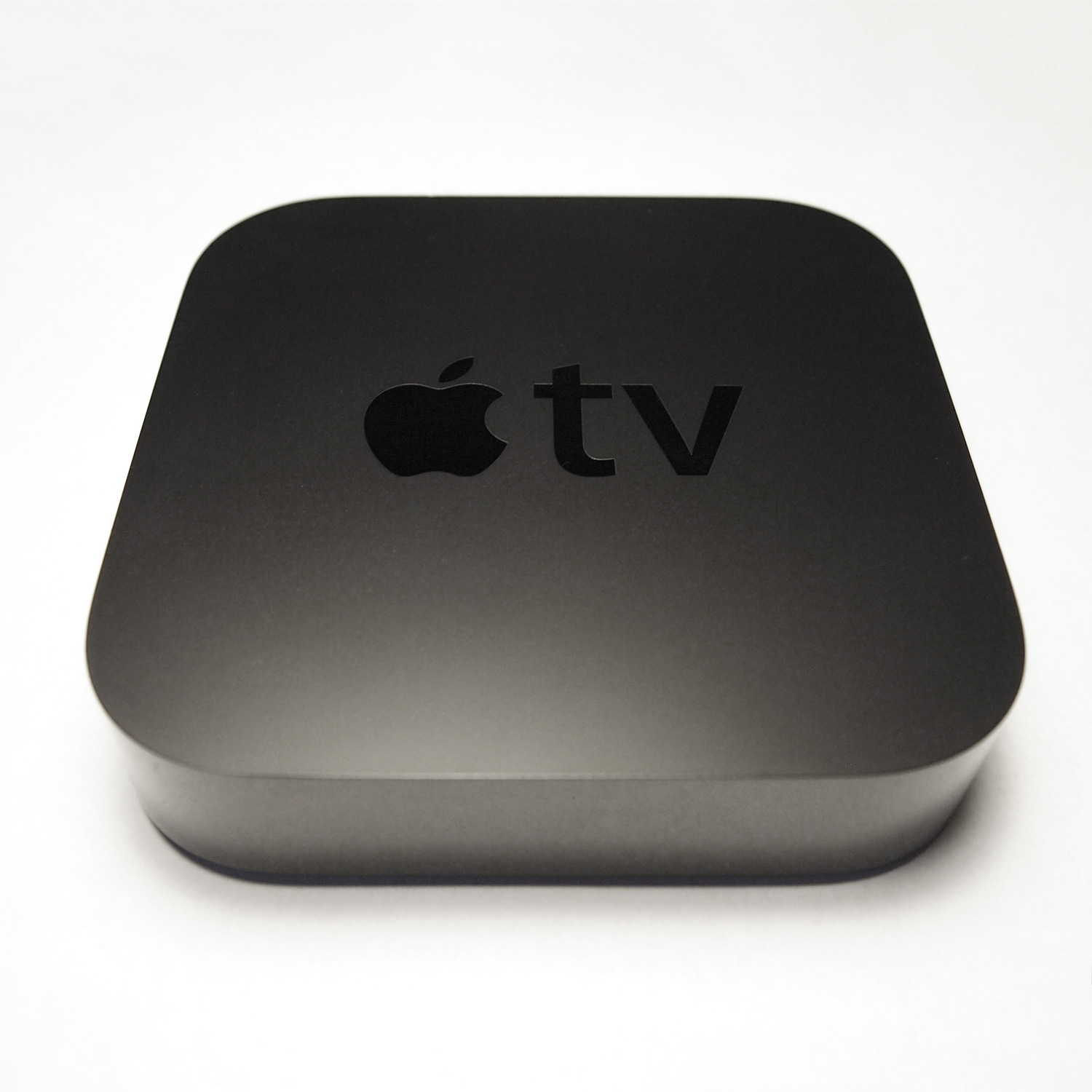
Apple TV — $99.00

Apple TV

So, you have iTunes, and tons of movies, but can only watch then on your iPhone or iPad. Same with your streaming Netflix account, Hulu Plus, HBO Go, etc. So what do you do? You get Apple TV. It’s a device that takes these entertainment streams and puts them onto your television screen. Sound useful? It is. The device can be used to project photos, games, apps, YouTube, and so on. Only possible setback – if you don’t have an apple device, it probably won’t prove very useful.

Apple TV is available for $99.00.

apple.com 


THE ALTERNATIVE

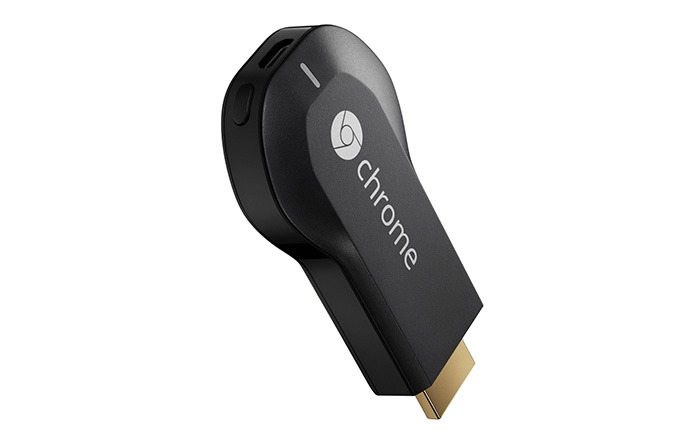
Google Chromecast — $35.00

Chromecast $35

Google has recently come out with the answer to streaming devices such as Apple TV – the Google Chromecast. It’s a small USB-looking device which does, well, the same thing. The Chromecast receives your streaming entertainment wirelessly and connects to your TV’s HDMI hookup, displaying your media on the big screen. Netflix, Hulu, YouTube, Google Chrome, HBO Go, and many other mediums are included, and at a much lower price.

The Google Chromecast is available for $35.00.

google.com


3.

HOT ITEM

Apple iPad Air (32 GB with WiFi and LTE) — $729.00

apple_ipad_air 32g wifi LTE $729.00

Not much need be said about this one; Apple usually is in the forefront of the hottest tech items for the Christmas season. This year is no exception. The new iPad air is the lightest full-range tablet, with retina-display graphics and a pristine processor. The sleek look of the iPad is one of its biggest selling points, coupled with its reputation overall. The price, however, holds true to Apple standards, cutting a large dent into any purchaser’s finances.

The iPad Air is available with multiple options from $499.00 to $929.00.

apple.com


THE ALTERNATIVE

Google Nexus 7 (32 GB with WiFi and LTE)  — $349.00

Nexus-7


The Nexus 7 has been rated one of the best tablets for 2013 by techradar.com. While it might not be the holy grail of tablets, it’s a very smart and sleek alternative. The device features countless apps and the display is sharper than most tablets on the market. For business or pleasure, if the iPad is too large an investment, the Nexus 7 would be the smart way to go.

The Google Nexus 7 is available with multiple options from $229.00 to $349.00.

google.com


4.

HOT ITEM

Samsung Galaxy Gear Smartwatch — $299.99

samsung-galaxy-gear


Smartwatches are emerging, and fast. It’s not just a watch – it’s connected to your phone. The most popular smartwatch on the market right now – The Samsung Galaxy Gear. This watch, with a digital touch display: displays your emails, displays your texts, locks/unlocks your phone, makes hands-free calls, uses voice commands, and more. The one big obvious negative – the watch only syncs with Samsung phones.

The Samsung Galaxy Gear Smartwatch is available for $299.99.

samsung.com


THE ALTERNATIVE

Pebble Smartwatch  — $150.00

pebble smartwatch


The Pebble Smartwatch is a fully functional wireless smartwatch that syncs with Android and Apple smartphones. With a less colorful display, it’s certainly an alternative to other smartwatches, but features a wide range of useful tasks, including text display, email display, music selection, alarms, and fitness apps. The Pebble does what you need for half the price.

The Pebble Smartwatch is available for $150.00.

getpebble.com


5.

HOT ITEM

Apple iPhone 5s (32 GB) — $299.99

iphone_5s


It’s the hottest phone on the market, and the only smart-phone featuring fingerprint technology. The sleek iPhone 5s sells itself, boasting retina display, fingerprint recognition, a super-fast processor, and two HD cameras.

The iPhone 5s is available with multiple options from $199.00 to $399.00.

apple.com


THE ALTERNATIVE

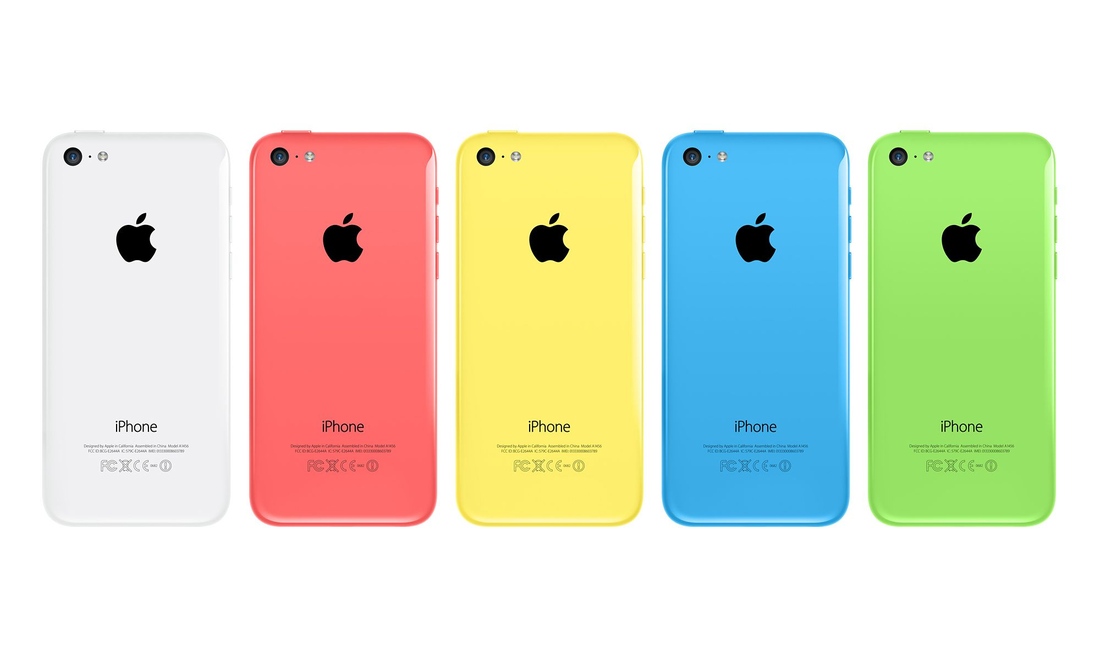
Apple iPhone 5c (32 GB)  — $199.00

iphone5c


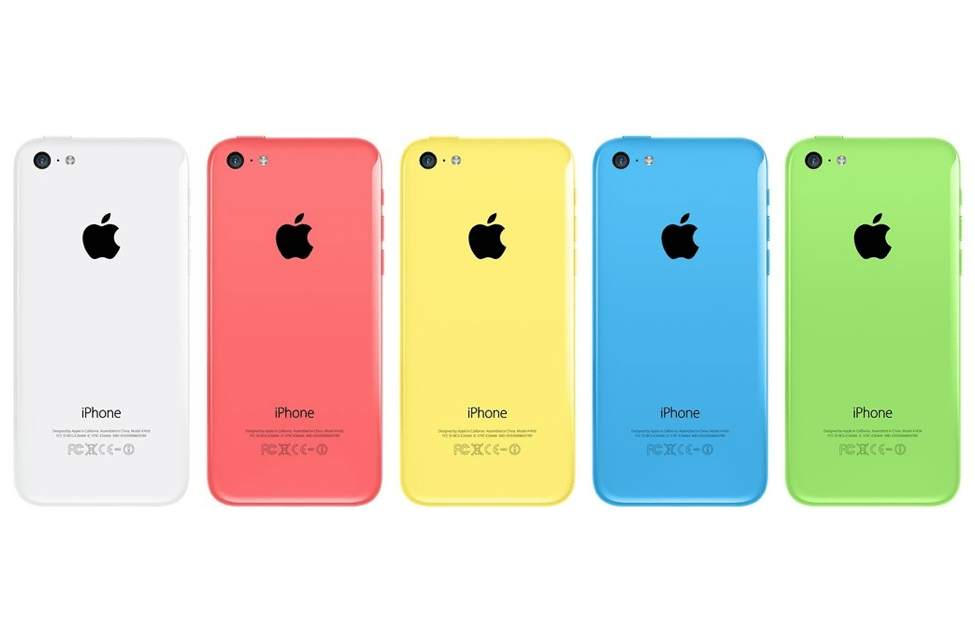
Same Phone. Same company. Four very different elements: The shell is plastic, as opposed to its aluminum counterpart on the 5s –  A slightly slower processor – Only the rear camera is HD – No fingerprint technology. With all of these in mind, the difference of about 100 dollars certainly makes up for what is missing considering the phone is still a highly functioning iPhone.

The iPhone 5c is available with multiple options from $99.00 to $199.00.

apple.com


6.

HOT ITEM

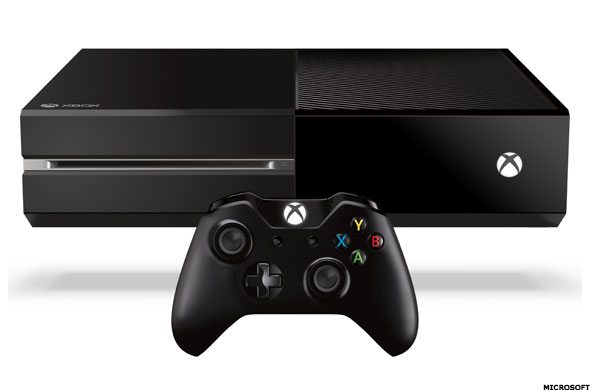
Xbox One  — $500.00+

XBOX1


This one will probably take the cake this year as the hottest selling item. The Xbox One sells itself. It supports the most popular games with the most pristine graphics, features streaming of movies and television shows, and features skype built in, to chat with fellow gamers or family & friends whenever you want. And, you can do all those things simultaneously. Given its popularity, the price of the One is rising as the Christmas deadline approaches, growing from a base price of $500. Retailers are selling it currently from as low as $500 to as high as $700 plus.

The Xbox One is available for at or around $500.00.

xbox.com


THE ALTERNATIVE

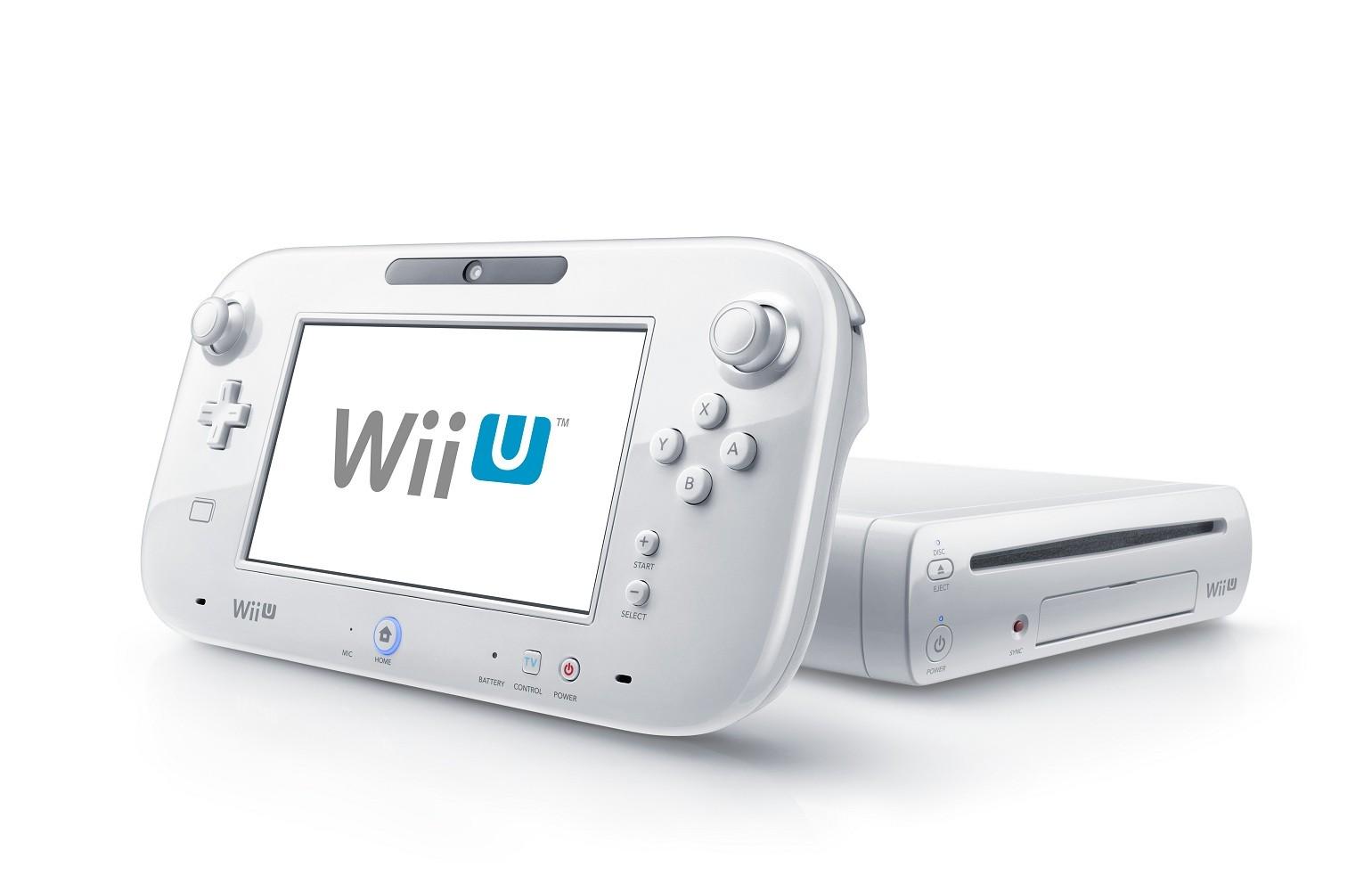
Wii U — $299.00

Wii_u


Trust us, they’ll love this one just as much. Yes it’s been on shelves for over a year, but the Wii U is still going strong, offering users an immersive gaming experience which puts the elements of the game both on the big screen and in their hands. The Wii U by all means stands up to the competition, and is nicely priced at 200 dollars less.

The Wii U is available for $299.00.

nintendo.com


7.

HOT ITEM

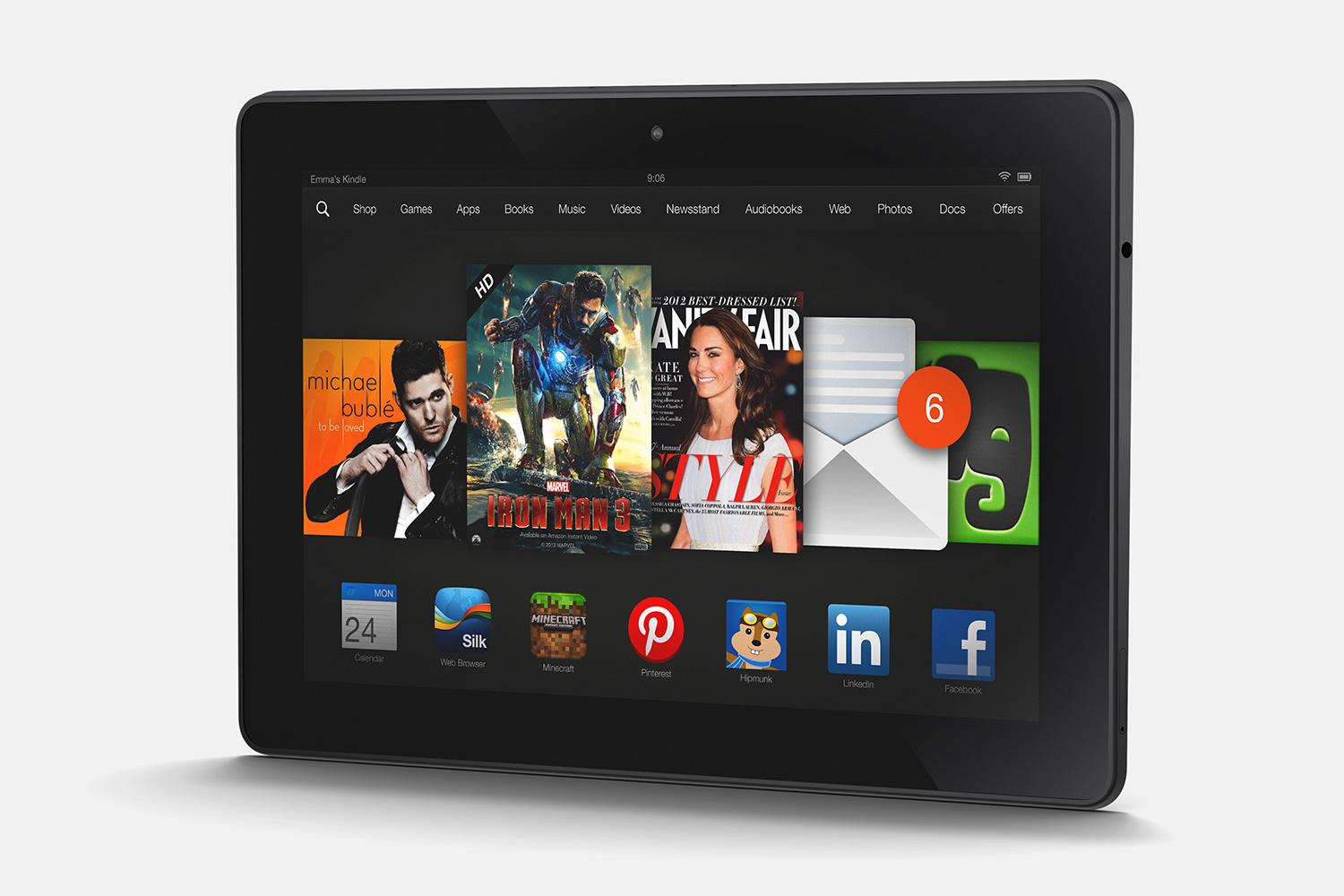
Amazon Kindle Fire HDX (32 GB with WiFi and 4G)  — $369.00

Kindle-Fire-HDX WiFi 4G 32g $369


Tablets and readers: can’t go wrong with those this Christmas. And the Kindle Fire HDX surely measures up. It features sharp color display, several apps and display options, WiFi, and 4G capability (addition monthly plan). This reader is more than a book reader, offering email, games, social media apps, and documents. If it’s the reading you’re serious about however, you might want to check out the alternative.

The Kindle Fire HDX is available with multiple options from $229.00 to $424.00.

amazon.com


THE ALTERNATIVE

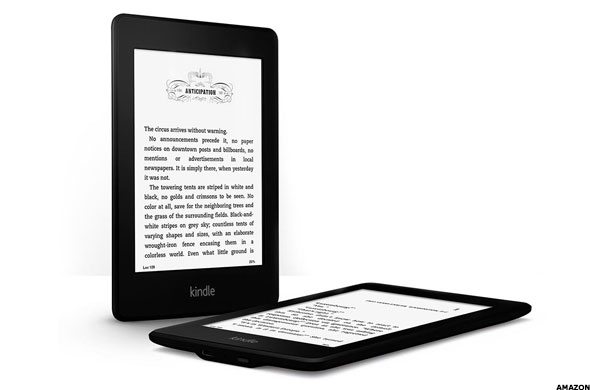
Amazon Kindle Paperwhite (WiFi and 3G) — $189.00

kindle paperwhite

Plain and simple, it’s a reader. There are no other functions like apps or video, just books. What makes the Paperwhite different is the display. The screen is lit to give readers full and clear resolution in any light – even in the dark. It’s all you’ll need, holding up to 1,100 books.

The Kindle Paperwhite is available with multiple options from $119.00 to $209.00

amazon.com


Filed Under: ENTERTAINMENT, TECHNOLOGY Tagged With: amazon, Apple, bose, chopping, Christmas, gadgets, Google, pebble, Samsung, sonos, tech, technology, Wii, xbox

Guild Wars 2 – It’s Wintersday!

by Tim Morris

images

Guild Wars 2 is bringing you a White Christmas!


Avid MMO gamers will be pleased to know that Guild Wars 2‘s Wintersday events have returned to Tyria! Players can venture to the now snow-covered Lion’s Arch and participate in all kinds of fun activities! Snowball fights, escorting caravans with gifts, battling malfunctioning toys, a bell choir mini-game that is reminiscent of Guitar Hero, and Toypocalypse, where you must protect gifts from angry toys, are all part of this content update. Alongside this content is a boatload of new achievements, along with titles, gift boxes, loot bags, and a whole lot more to satisfy your Christmas spirit. In my estimation, this is the best update to the Guild Wars 2 Living Story since Halloween’s Mad King Returns event.

As someone who missed out on Wintersday last year due to being burnt out from the game (followed by losing my account password), this content is all new to me. While running around Tyria, I’ve instantly felt deprived for missing out on all the fun from a year ago. Unwrapping huge gift boxes in the open world, only to have them explode and release hostile armies of angry toys was certainly a fun surprise, though in the higher level zones this becomes more of a hassle to deal with than it’s really worth; one can simply bypass the boxes, however, so the choice is up to the player. The player vs. player Snowball Mayhem activity features two teams duking it out in a winter wonderland. Players are awarded points for defeating opponents as well as carrying a gift back to their base. Another piece of content that I found entertaining was the new dungeon, where you help Toymaker Tixx keep his workshop under control and operating smoothly. There is much to do this Wintersday, and so ArenaNet has stated that these events will persist for a month, until January 10th. After all the flops that the Living Story has produced since Halloween (namely the entire Tower of Nightmares arc), this is one update that I’m going to miss once it’s gone.

One more update to the game is the release of ascended armor. With ascended weapons and trinkets already in the game, armor will allow players to complete their gear sets and maximize their effectiveness. Naturally, it’s a huge grind to gain all the materials needed to make the armor, and taking a shortcut by buying completed components on the trading post is going to leave a huge hole in your virtual wallet. Unfortunately, not all characters are on an even playing field when it comes to crafting these goodies. While heavy and medium classes have had opportunities to craft items that can also be used on armor in the weaponsmith and huntsman professions, light classes have had no previous method of acquiring the cloth needed to make their armor. My two level-capped characters are both light classes, so it’s an inconvenience for me. However, removing all biases this is something that should have been addressed prior to the release of the update. I’m still going to make at least one set of ascended, it’s just going to take me longer than some of my friends who play warriors and thieves.

As always, this Guild Wars 2 content update is free to download and will do so automatically once you start up the game. Happy hunting!

For more information about Wintersday, click here

Filed Under: ENTERTAINMENT, OPINION, REVIEWS, TECHNOLOGY, uncategorized Tagged With: arenanet, Christmas, download, games, guild wars 2, MMO, rpg, Tyria, update, Wintersday

The Singularity – Why You Should Start Paying Attention

by Alex David Jimenez

Screen Shot 2013-12-09 at 4.22.16 PM

It is a concept which easily escapes the minds and comprehension of most given the scope of its significance. The singularity is a theoretical and mathematically predicted event set to occur in the near future. What sort of event? Well to put it bluntly, an event which will alter our entire planet and the way we live our lives. The singularity is near. Whether or not you believe it will occur, on some level, it has already started.

The Singularity:

“A future period during which the pace of technological change will be so rapid, its impact so deep, that human life will be irreversibly transformed. Although neither utopian nor dystopian, this epoch will transform the concepts that we rely on to give meaning to our lives, from our business models to the cycle of human life, including death itself.” – Ray Kurzweil

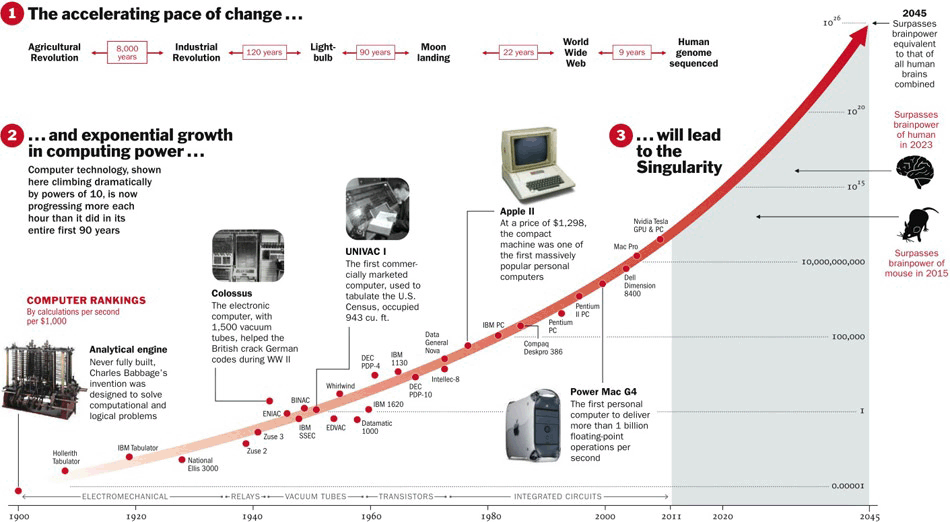
In simpler terms, the singularity is a exponentially based hypothetical which says that the growth of technology, pertaining to the size and capabilities of individual computer processing units, is rising at such a rapid pace that it will surpass human intelligence within this century. Ray Kurzweil, an American author and futurist, is the foremost authority on the singularity, citing many strong evidential theories as to why this is indeed a real event. According to Kurzweil, given the current pace of technology growth (the current pace of technology growth rises more each single hour than it did in its first 90 years of existence combined – see chart), the singularity, which is a “zero point” where the intelligence of the technological world will surpass that of humanity, shall occur in or around the year 2045. Wrap your head around that. Most of you reading this will be alive in the year 2045.

The chart below gives a view of the rising of technological growth. The rise of growth is not a straight line, but indeed curves upward, and will eventually become a straight line. That is the singularity.

Moores law


Need a little more breakdown and explanation? Watch This Video.

So what does this mean for us? Well, according to futurists, it means a complete change in the way we live our lives. Completely. In the coming years, great advances in science are expected, including graphic and virtual reality advances so pristine that the actual world and the virtual world will be indistinguishable. Kurzweil describes a future society where most of humanity lives in the virtual world most of the time, using it to live out fantasies and escape their lives. Nanorobotics is also expected to emerge, which is a science with endless possibilities. Imagine robots small enough to be injected into your bloodstream to prevent heart attacks, or prevent infections. Imagine robots small enough to eradicate cancer, or kill a cold virus before you even feel symptoms, or gather and burn fat within your body while you sit at your desk. As hard as it is to imagine, it’s being developed right now.

One can easily see how such advancements in technology would be astoundingly good for us as a species. But there are of course negative aspects to the singularity. To begin with, fully self-aware artificial intelligence. It doesn’t take a Terminator film to know that intelligent machines which are potentially billions of times smarter than us is not something that rests so easily in the back of your mind. The year 2045 is when the development of technology is expected to be “taken over” by technology itself, and is expected to thereafter grow at a pace faster than we as humans can even comprehend. In the interest of looking at technology as a series of individual and collaborative machines, we will have in essence created a new species and will have built them with the ability to advance themselves at their own free will.

Kurzweil wrote a fascinating book called “The Singularity is Near” in 2005 in which he actively predicts significant events and milestones in the growth of technology in the coming decades. While the events are certainly not exact (they are predictions based on exponential growth; Kurzweil cannot predict the future), they are in many cases feasible, and as a whole, incredibly overwhelming:

2010

  • Supercomputers will have the same raw computing power as human brains, though the software to emulate human thinking on those computers does not yet exist. (IBM Sequoia)
  • Computers will start to disappear as distinct physical objects, meaning many will have nontraditional shapes or will be embedded in clothing and everyday objects.
  • Full-immersion audio-visual virtual reality will exist.

2010s

  • The decade in which “Bridge Two”, the revolution in Genetics/Biotechnology, is to reach its peak. During the 2010s, humans will have the means of changing their genes; not just “designer babies” will be feasible, but designer baby boomers through the rejuvenation of all of one’s body’s tissues and organs by transforming one’s skin cells into youthful versions of every other cell type. People will be able to “reprogram” their own biochemistry away from disease and aging, radically extending life expectancy.
  • Computers become smaller and increasingly integrated into everyday life.
  • More and more computer devices will be used as miniature web servers, and more will have their resources pooled for computation.
  • High-quality broadband Internet access will become available almost everywhere.
  • Eyeglasses that beam images onto the users’ retinas to produce virtual reality will be developed. They will also come with speakers or headphone attachments that will complete the experience with sounds. These eyeglasses will become a new medium for advertising as advertising will be wirelessly transmitted to them as one walks by various business establishments. This was fictionalized in Dennō Coil.
  • The VR glasses will also have built-in computers featuring “virtual assistant” programs that can help the user with various daily tasks.
  • Virtual assistants would be capable of multiple functions. One useful function would be real-time language translation in which words spoken in a foreign language would be translated into text that would appear as subtitles to a user wearing the glasses.
  • Cell phones will be built into clothing and will be able to project sounds directly into the ears of their users.
  • Advertisements will utilize a new technology whereby two ultrasonic beams can be targeted to intersect at a specific point, delivering a localized sound message that only a single person can hear. This was fictionalized in the films Minority Report and Back to the Future Part II.

2015

  • By now, it is likely that “clean a house” will be within the capabilities of a household robot.

2018

  • 1013 bits (=10 TB) of computer memory—roughly the equivalent of the memory space in a single human brain—will cost $1000.

2020s

  • The decade in which “Bridge Three”, the revolution in Nanotechnology, is to begin: allowing humans to vastly overcome the inherent limitations of biology, as no matter how much humanity fine-tunes their biology, they will never be as capable otherwise. This decade also marks the revolution in Robotics (Strong AI), as an AI is expected to pass the Turing test by the last year of the decade (2029), meaning it can pass for a human being (though the first A.I. is likely to be the equivalent of an average, educated human). What follows then will be an era of consolidation in which non-biological intelligence will undergo exponential growth (Runaway AI), eventually leading to the extraordinary expansion contemplated by the Singularity, in which human intelligence is multiplied by billions by the mid-2040s.
  • Early in this decade, humanity will have the requisite hardware to emulate human intelligence within a $1000 personal computer, followed shortly by effective software models of human intelligence toward the middle of the decade: this will be enabled through the continuing exponential growth of brain-scanning technology, which is doubling in bandwidth, temporal and spatial resolution every year, and will be greatly amplified with nanotechnology, allowing us to have a detailed understanding of all the regions of the human brain and to aid in developing human-level machine intelligence by the end of this decade.
  • Computers less than 100 nm in size will be possible.
  • As one of their first practical applications, nanomachines are used for medical purposes.
  • Highly advanced medical nanobots will perform detailed brainscans on live patients.
  • Accurate computer simulations of the entire human brain will exist due to these hyper-accurate brain scans, and the workings of the brain will be understood.
  • Nanobots capable of entering the bloodstream to “feed” cells and extract waste will exist (though not necessarily be in wide use) by the end of this decade. They will make the normal mode of human food consumption obsolete.
  • By the late 2020s, nanotech-based manufacturing will be in widespread use, radically altering the economy as all sorts of products can suddenly be produced for a fraction of their traditional-manufacture costs. The true cost of any product is now the amount it takes to download the design schematics.
  • By the later part of this decade, virtual reality will be so high-quality that it will be indistinguishable from real reality.
  • The threat posed by genetically engineered pathogens permanently dissipates by the end of this decade as medical nanobots—infinitely more durable, intelligent and capable than any microorganism—become sufficiently advanced.
  • The many variations of “Human Body 2.0” (as Kurzweil calls it) are incrementally accumulated into this and the following decade, with each organ and body system having its own course of refinement and development. It ultimately consists of a nano-technological system of nourishment and circulation, obsoleting many internal organs, brain-extension and an improved skeleton.

2023

  • 1016 calculations per second—roughly the equivalent of one human brain—will cost $1,000.

2025

  • The most likely year for the debut of advanced nanotechnology.
  • Some military UAVs and land vehicles will be 100% computer-controlled.

2030s

  • Mind uploading becomes successful and perfected by the end of this decade as humans become software-based: living out on the Web, projecting bodies whenever they want or need (whether in virtual or real reality), and living indefinitely so long as they maintain their “mind file”. Eventually, all human beings (including those with transbiological 2.0 or 3.0 bodies) will migrate to this postbiological state except for those who wish to remain unenhanced: the transbiological era giving way to the postbiological era.
  • Nanomachines could be directly inserted into the brain and could interact with brain cells to totally control incoming and outgoing signals. As a result, truly full-immersion virtual reality could be generated without the need for any external equipment. Afferent nerve pathways could be blocked, totally canceling out the “real” world and leaving the user with only the desired virtual experience.
  • Brain nanobots could also elicit emotional responses from users.
  • Using brain nanobots, recorded or real-time brain transmissions of a person’s daily life known as “experience beamers” will be available for other people to remotely experience. This is very similar to how the characters in Being John Malkovich were able to enter the mind of Malkovich and see the world through his eyes.
  • Recreational uses aside, nanomachines in people’s brains will allow them to greatly expand their cognitive, memory and sensory capabilities, to directly interface with computers, and to “telepathically” communicate with other, similarly augmented humans via wireless networks.
  • The same nanotechnology should also allow people to alter the neural connections within their brains, changing the underlying basis for the person’s intelligence, memories and personality.
  • The many variations of “Human Body 3.0” are gradually implemented during this and the following decade; It mostly likely lacks a fixed, corporeal form and can alter its shape and external appearance at will via foglet-like nanotechnology.

2040s

  • People spend most of their time in full-immersion virtual reality (Kurzweil has cited The Matrix as a good example of what the advanced virtual worlds will be like, without the dystopian twist).
  • Foglets are in use.
  • Nonbiological intelligence will be billions of times more capable than biological intelligence.

2045: The Singularity

  • $1000 buys a computer a billion times more intelligent than every human combined. This means that average and even low-end computers are vastly smarter than even highly intelligent, unenhanced humans.
  • The technological singularity occurs as artificial intelligences surpass human beings as the smartest and most capable life forms on the Earth. Technological development is taken over by the machines, who can think, act and communicate so quickly that normal humans cannot even comprehend what is going on. The machines enter into a “runaway reaction” of self-improvement cycles, with each new generation of A.I.s appearing faster and faster. From this point onwards, technological advancement is explosive, under the control of the machines, and thus cannot be accurately predicted (hence the term “Singularity”).
  • The Singularity is an extremely disruptive, world-altering event that forever changes the course of human history. The extermination of humanity by violent machines is unlikely (though not impossible) because sharp distinctions between man and machine will no longer exist thanks to the existence of cybernetically enhanced humans and uploaded humans.

Post-2045: “Waking up” the Universe

  • The physical bottom limit to how small computer transistors (or other equivalent, albeit more effective components, such as memristors integrated into Crossbar latches) can be shrunk is reached. From this moment onwards, computers can only be made more powerful if they are made larger in size.
  • Because of this, A.I.s convert more and more of the Earth’s matter into engineered, computational substrate capable of supporting more A.I.s. until the whole Earth is one, gigantic computer, except for a few nature reserves set aside on the planetary surface for those humans who decided to remain in their natural state. “MOSH’s” (Mostly Original Substrate Human) who choose to remain purely organic would still possess virtual assistants that will act as their transcendent servants, living in the blurred real world (“foglet-reality”) and being provided with environments and everything they could possibly need as they live out the rest of their normal lives unless they enhance themselves.
  • At this point, the only possible way to increase the intelligence of the machines any farther is to begin converting all of the matter and energy in the universe into similar massive computers. A.I.s radiate outward from Earth, first into the Solar System and then out into interstellar space, then galaxies in all directions, utilizing starships that are Von Neumann probes with nanobot crews, breaking down whole planets, stars, moons, and meteoroids and reassembling them into computers. This, in effect, “wakes up” the universe as all the inanimate “dumb” matter (rocks, dust, gases, etc.) is converted into structured matter capable of supporting life (albeit synthetic life).
  • Kurzweil predicts that machines might have the ability to make planet-sized computers by 2099, which underscores how enormously technology will advance after the Singularity.
  • The process of “waking up” the universe could be completed well before the end of the 22nd century, provided humans are not limited by the speed of light.
  • With the entire universe made into a giant, highly efficient supercomputer, AI and human hybrids (so integrated that, in truth it is a new category of “life”) would have both supreme intelligence and physical control over the universe. Humanity will still not possess infinite levels of any attributes, as the accelerating change of evolution never reaches an infinite measure (though it moves rapidly in that direction), becoming, as Kurzweil writes, “moving inexorably toward this monotheistic conception of God, though never reaching this ideal”; even with theories such as the holographic universe. The final chapter however notes that, if possible, the ability to create and colonize other universes (and if there is a way to do this, humanity’s vast intelligence is likely to harness it, as with surpassing/bypassing the speed of light) could allow the intelligence of the human/machine civilization to extend indefinitely, akin to a mathematical singularity. If not, then saturating humanity’s own universe will remain their ultimate fate.                

– via Wikipedia.org

As members of the current race of humanity, it should be impossible for the occurrence of the singularity or anything like it not to affect and completely change the lives of every living person. As Kurzweil outlines in his writings, a post-singularity world would potentially be life on a completely different planet.

There is much debate as to whether or not this epoch of human life will even occur, or if so, to what extent. But it can be said that the evidence is certainly all around us. Each year cell phones and computers get smaller and thinner. Processing units grow in capacity and shrink in size. Medical breakthroughs are made every day. The theory that technology is certainly growing at a consistently faster pace is anything but a theory. Over 1.4 billion citizens of the planet earth have smartphones. Medicine utilizes more machinery as replacement body parts every year. The fact is, no matter which direction we move as a society, the singularity, or an event like it, is near. What is the best way to prepare? Stay informed, and know what to expect.

Filed Under: SCIENCE, TECHNOLOGY Tagged With: AI, machines, manhattan digest, science, singularity, technology, the future

Cyber Monday Sales Top 2 Billion

by Alex David Jimenez

Cyber Monday 2013_photo via iphonehacks.com

And so, as the bruised and battered shoppers from across the fifty holiday-engorged states made their way back to their homes and questionable leftovers, a new beast lay in waiting behind their inauspicious computer monitors and tablets. The Monday after the turkey and gravy fest, and after the menacing crowds and monsters of Black Friday, is the latest great opportunity to present consumers with yet more ridiculous sales and deals – all now available conveniently within the safety of their own homes. It was Cyber Monday. Shopping online was madness. At nightfall the internet sat in the corner of the shower and wept. One phrase surely graced more computer monitors than on any other given day throughout the year: This Site is Temporarily Down.

Cyber Monday is a fairly recent cultural phenomenon. It began in 2005. A press release was conducted by the company Shop.org, publicly stating that the Monday following Thanksgiving was quickly becoming one of the busiest online shopping days of the year. This was based on the numbers of the previous year: The monday following Thanksgiving had been in the top 12 busiest online shopping days of 2004. Shop.org decided to attempt throwing the e-commerce community on the Black Friday bandwagon. It worked. That Cyber Monday saw record numbers: numbers which have increased annually since.

This year broke a new record, pushing online sales over the 2 billion dollar mark in a single day. $2.29 billion dollars to be exact.

Cyber Monday Profits 

2006 – $610,000,000

2007 – $730,000,000

2008 – $846,000,000

2009 – $887,000,000

2010 – $1,028,000,000

2011 – $1,251,000,000

2012 – $1,465,000,000

2013 – $2,290,000,000


In contrast, sales for the 2013 Black Friday weekend went down for the first time in seven years. Falling 2.9% from last year’s sales, this year saw 57.4 billion dollars in profits for the weekend. That is a significant pullback considering the numbers had been on the rise every year since 2006. Last year saw 59.1 billion dollars in sales.

The most evident thought-process to be reached by these numbers is right in front of us: everything is moving into the digital age. Cyber Monday was not only successful – it was phenomenal. It wasn’t just the computers either. A whopping 18.3% of online sales were found and processed using tablets and smart phones. Cyber Monday is becoming easier to do, so naturally the numbers are rising. Black Friday is a time-honored and kind of scary tradition, sure, but why chance being flattened to the ground by high-tops and pumps in front of a Walmart when you can sit in your pajamas and work those index-finger muscles?

Cyber Monday CrashesIt’s not perfect yet. There were, as there always are, some technical problems while dealing with the massive number of visitors on e-commerce sites. Several sites did crash due to an overload of volume, including Motorola, Toys’R’Us, Urban Outfitters, Brookstone, Nordstrom, and Barnes & Noble. While most of these companies were back online within a few minutes, they potentially lost hundreds of thousands of dollars in their absence.

If there is a moral to the story that was Black Cyber Weekend, it must be that, well, we’re all a bunch of greedy and impatient barbarians, and the machines will soon be taking over.


Sources: Wikipedia.org, Business Insider, Bloomberg News


Filed Under: BUSINESS, OPINION, TECHNOLOGY Tagged With: america, Black Friday, crashes, Cyber Monday, Internet, opinion, shopping, technology, Thanksgiving

Knack – Full Review

by Tim Morris

Copyright Sony Computer Entertainment Source: VGU
Copyright Sony Computer Entertainment
Source: VGU

Its beauty is only skin-deep.

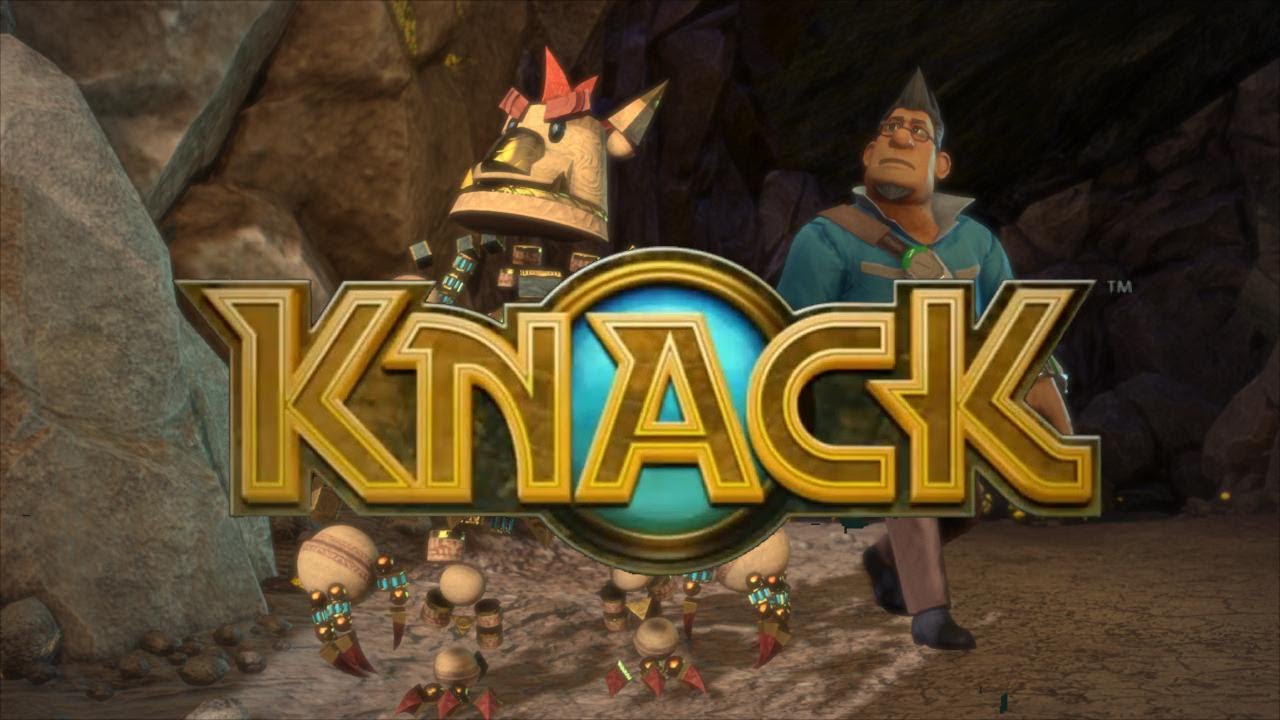
Now that I’ve had the opportunity to complete my playthrough of Knack, I think it’s high time that I give it a proper review. Knack was developed in-house by Sony as an answer to those wanting new entries in the Ratchet & Clank series or similar titles. It serves as the Playstation 4’s kid-friendly foray into the blend of action and platforming at launch, and also is a nice break from all the shooters that have come out alongside the platform. Is it a good game, though? Yes and no.

Story – Knack begins with a meeting of the minds, of sorts. It follows the stories of Doctor Vargas, who was responsible for the creation of the eponymous protagonist, Knack; Lucas, the Doctor’s assistant; and Ryder, the poor man’s Indiana Jones who is also Lucas’s uncle. Other pertinent characters include Viktor, a shady executive whose love of robotics and high-tech weaponry has powered his empire; Katrina, Viktor’s head of security and femme fatale; and Charlotte, the Doctor’s former lover, presumed dead after falling into an abyss twenty years prior to the game’s occurrence. At the outset of the game, you’re told that the goblins are a prime threat to human cities and settlements and that they must be stopped, which is where we meet the cast and see them discuss the best course of action. The story then shifts to Viktor being an evil son of a gun, and then it kind of gets disjointed from there. There are thirteen “chapters” to the game’s story, yet by the middle of chapter five it felt like endgame. After that, it was a series of buildups to potentially major encounters with little to no payoff. You do eventually get to battle one of the main villains, but the final boss of the game is almost completely unexplained. If you were fighting Viktor’s minions, you’d reach a point where a fight against Viktor and/or Katrina would be teased heavily, only to have them run away with their tails between their legs before a cut to the next chapter. There is a rather significant plot twist in the second half of the game that was fairly well-executed, but the overall body of work with the story is marred by a number of unexplained events and plot holes. Since I’d like to keep this review as spoiler-free as possible, I won’t mention specifically what happens, but you can find a video with all the cutscenes edited together here.
Story Grade: D+

Gameplay – Knack plays like your typical action platformer, except on a more linear scale than most. Nearly every level in the game is set on a clearly defined path from start to finish, so you’ll never get lost or forget where you need to go. As far as level design goes, those are really the only positives about linearity. With so little room for exploration aside from a few breakable walls and secret rooms, I felt at times that Knack was more about working my way through the mobs to the end of the level than exploring and taking in the beautiful visuals that were created for this title. That’s one of the biggest issues this game has; playing a video game should never feel like work. Another gripe I have with the game is the controller mapping. Knack has three basic maneuvers: he can jump (X button), punch (square button, can be pressed repeatedly to string together hits), and evade (moving the right stick). As a veteran of shooting games, I find it aggravating when I can’t jump and aim, which are typically on the bottom face button and right stick, respectively, in a fluid motion. Evading is awkward enough in its own right, especially because the timing is tough to nail down and you aren’t granted any additional invincibility frames while you’re stuck recovering, which means that other enemies on the field can still hit you. Potentially the largest issue with the controller setup is the fixed camera. With nothing else mapped to the shoulder buttons, it’s inexcusable that there is no way to rotate the camera. This is 2013, people. Having moments in the heat of battle when enemies drop in the foreground, obscuring my character, with no way to remedy that except to jump over them and possibly take a hit in the process is highly unforgiving.

Knack can collect sunstone to unleash one of three special abilities by pressing the O button followed by O again, square, or Δ. These serve to quickly clear the area of enemies if you’re in a tight spot, but for me they were used more for breaking the monotony of the “punch everything” system when I didn’t feel like fighting a mob. Tying into the sunstone feature is the checkpoint system. If you die, and trust me, you’re going to die a lot in this game, sunstone does not revert to what it was at when you hit the last checkpoint. This works two ways: the positive is that you can sort of grind sunstone through dying a bunch, eventually giving you enough to use a super move and clear the fight that you were having trouble with; however, the opposite side of the coin is that should you use some of your meter on a super move and then die anyway, you’re stuck grinding it out again unless you can prevail without it. This brings me to another issue I take with the gameplay, which is that due to how quickly Knack dies no matter how big he gets, the name of the game is memorizing attack patterns and defensive play, as opposed to instincts and skill. This type of “know your enemy” system doesn’t sit well with me, especially in a game that’s allegedly geared towards children. I don’t know what types of kids they’re targeting with this game, but the “Normal” difficulty of Knack is plenty frustrating enough.
Gameplay Grade: D

Aesthetics – The saving grace of Knack is the graphics. With cutscenes and landscapes that could pass for a DreamWorks film, this is an impressive piece of visual artwork. The game runs smoothly, with very few slowdowns occurring from start to finish. Landscapes range from mines to mountains to forests to cities and everything in-between. Goblin enemies look like dumber and evil versions of Shrek, which actually works pretty well. The true winner in the graphical department is Knack, of course, because he has so many moving parts and his size changes rather frequently. Though it sadly has no effect on the gameplay itself aside from certain sections, the extra materials that Knack can utilize over the course of the game, whether ice, wood, metal, or crystal, are all rendered nicely and add a bit of visual flair to the game. Sunstone pickups glow and cause Knack to illuminate as well when they are broken and consumed. I keep coming back to the FMVs in the game though. They’re very well-animated, with solid voice acting and crisp sound effects. It’s a shame that they’re wasted on an inner core of a game with such little depth to it, but perhaps someday there will be a sequel that has combat equal to its animation.
Aesthetics Grade: A-

Fun Factor/Replay Value – Hardcore trophy hunters will be glad to know that there is a lot to do postgame. Subsequent playthroughs will allow players to re-open chests in secret rooms, in order to complete the many gadgets that Knack can use and also gain crystals that allow Knack to become better versions of himself. Whether or not you choose to pursue those upgrades and accolades depends on how much you enjoy the overall package here. I probably won’t be going back to Knack, not for a long while at least. This is not to say that the game is completely devoid of enjoyment, however; the game really shines when Knack grows to enormous proportions and you can run through areas while killing almost everything in one hit and flinging tanks at the opposition. I took these sections of the game as sick, twisted revenge against it for the profanity and near controller throwing it caused me, but how you enjoy these sequences is completely up to you. To summarize this section, if you don’t mind farming or grinding to obtain some power-ups and have a superhuman resistance to the mind-numbing gameplay of Knack, go nuts.
Fun Factor/Replay Value Grade: C-

Final Thoughts – I want to like Knack. I really, really do. I want it to be the Crash Bandicoot or Spyro of its generation, that seminal action platforming game that redefines a genre and gets the masses playing something other than a first-person shooter for a change. However, there simply isn’t enough here to be that game. It doesn’t do much that we haven’t already seen, and the unforgiving difficulty means that Knack isn’t the most accessible launch title in the PS4’s library. This title is yet another example of how graphics are not the most important factor in a video game’s quality. If the development team had spent even half as much time on everything else in Knack as they did on the visuals, it might have been one of the better launch titles for the Playstation 4. As it stands, it’s a beacon of mediocrity that left me very disappointed.
Final Grade: C

Platform: Playstation 4
Genre: Action/Adventure, Platforming
Players: 1-2 (co-op)
Price: $59.99

Filed Under: ENTERTAINMENT, OPINION, REVIEWS, TECHNOLOGY, uncategorized Tagged With: action, adventure, knack, opinion, platforming, playstation 4, review, video games

The Hashtag: The Most Powerful Tool on the Internet

by Alex David Jimenez

The Hashtag: A word or phrase preceded by a hash mark (#), used within a message to identify a keyword or topic of interest and facilitate a search for it.

It seems, within today’s modern world, the idea of a society which is not completely interconnected and collectively influential is unfathomable and even somewhat frightening. What was the world without internet? What was a day without cell phones or computers? How did people communicate, or meet, or get directions, or stay entertained?

We have adapted to our modern world with ease, familiarizing ourselves with new technologies and social impacts every day. Certain trends have faded into the world of retro-vintage ancient history, while others have stood the test of time. Since the recent dawn of social media, the world has become significantly smaller. And when Twitter introduced the hashtag in 2007, a new trend was born. It was arguably the most powerful tool on the internet, and perhaps still is.

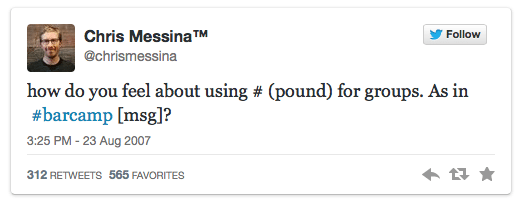
Screen Shot 2013-11-25 at 10.03.00 AMChris Messina, co-founder of the company BarCamp, was officially the first Twitter user to introduce and to actively “use” the hashtag as a means for guiding conversations among groups of people. The concept was initially frowned upon, both by general consumer consensus and by Twitter founders Ev Williams and Biz Stone themselves. The founders were uncertain of the potential for the emblem’s impact. They didn’t wholly believe it would catch on. “That stuff is never going to catch on,” they said. “We’re going to build algorithms, we’re going to figure it out, and you won’t have to use hashtags at all. We got it covered.” As it turns out, the hashtag proved itself a worthy tool when friend of Messina Nate Ritter  used the hashtag to tweet about the spread of 2007 San Diego forest fires. The trend caught on. Rather than simply existing as a social-circle engine, the hashtag became a source of live news coverage. It proved itself.

From there the hashtag only grew, becoming a worldwide phenomenon. The tool was used to collectively have a conversation about what was important to us, or what was popular in the world. The hashtag was certainly not under-appreciated once it became commonplace. Advertisers began to see the massive potential of the tool. Using the hashtag to follow what was popular among consumers was only the beginning. Soon companies began to pay for their hashtags to become viral, hoping to promote their products or services on a grand scale. It worked. The hashtag became a common visual piece on everyone’s texts. Our tweets were retweeted more. Our followers grew. Other companies, such as Instagram and Facebook began to use the hashtag, utilizing to its full potential the powerful keystroke. Television shows present hashtags during airtime, hoping to grab a larger audience. Some websites, like hashtracking.com, even offer services with which you can track the most influential tags at any given time.

What exists today is a sort of new universal language, so-to-speak. Using a hashtag can instantaneously connect you with people on the other side of the world. People can quite literally become famous using a single hashtag. This article itself could go viral just because of the hashtags used in its publication on twitter. It is quite arguably the most powerful tool in mainstream technology today. Governments certainly have begun to use the tool to their advantage as well, be it for the benefit of society, or for other sinister intentions. It’s important to pay attention now, with the strength behind this emblem, to the way we use it. As technology advances further, and the world becomes even smaller, everything we say, and everything we tag, belongs to the entire civilized world.

hashtag.jpg#mindblown

#hashtag

#whatdoyouhashtag

 #AMAs

source: forbes.com

Filed Under: TECHNOLOGY Tagged With: #, hashtag, influence, Internet, one direction, power, technology, thehashtag, Twitter

First Impressions: PS4 + Three Launch Titles

by Tim Morris

Copyright Sony Computer Entertainment Source: Geeks of Doom
Copyright Sony Computer Entertainment
Source: Geeks of Doom

PS4… worth the wait?

Ever since E3, there has been a lot to like about Sony’s new toy. Amid much fanfare, the Playstation 4 released this past Friday, and after spending some time with it today I must say I’m impressed. Sony’s user-friendly approach to this generation of consoles can be seen in just about every aspect of the new interface, with easy-to-find features and neatly organized menus. You can even go back to the system’s home menus without having to fully quit the game you’re playing, and can pick it back up whenever you choose. Streaming gameplay is nearly seamless and is always available with only a few button presses once you link your Twitch or Ustream account. It’s certainly a step up from the previous generation of consoles, and thus far I feel that I’ve received a great deal for my $400 purchase.

Perhaps the most attractive qualities of the PS4 when compared to Microsoft’s XBOX One are the financial ones: it’s $100 cheaper, its online service is $10 cheaper per year, and there are a good amount of free and discounted games available for download on the PSN Store. Aside from the launch title I pre-ordered, Knack, I also picked up and played a couple of the downloadable titles off the PSN Store, Warframe and Flower.

Copyright Sony Computer Entertainment Source: VGU
Copyright Sony Computer Entertainment
Source: VGU

I’m going to start my quick reviews with Knack. If you’ve ever played the old school Crash Bandicoot games or the Jak & Daxter series, you should have at least some idea of what to expect here. The gameplay of Knack is sort of a hybrid of those two entities. You play as Knack, a being made up of relics. You guide Knack through mostly linear levels, defeating enemies using either hand-to-hand combat or super moves, which must be charged by collecting sunstone. Knack’s maximum health is tied to his size, and at certain points you pick up enough relics to make him grow bigger and stronger. The graphics are very sharp, with cutscenes that look like they’re straight out of a Pixar movie. It’s clear that the in-house developers at Sony wanted this game to show off the capabilities of the Playstation 4, and they’ve accomplished that. However, not all is well here.
I’ve been a gamer for over 20 years now, and I have to admit the following: I find Knack to be a frustratingly hard game on its normal difficulty setting (there are easy and hard settings as well). Sadly, it isn’t difficult because of mechanics that the game teaches you along the way, or even a fulfilling battle system that rewards skilled play. No, Knack is rage-inducing because no matter how large your health bar is, you die in two to three hits. Damage appears to be percentage-based in this game, and so what the game’s battle system really rewards is patience, avoidance, and timing. This, combined with checkpoints and health-replenishing relic boxes that are oddly spaced make some levels drag on. Don’t get me wrong, I don’t mind difficulty in games – I come from the Sega Genesis generation where some games were nigh-impossible (Ecco the Dolphin anyone?)… but when you have a game that is clearly geared towards children, scaling the difficulty so that they have to play on the Easy setting is not the way to go. Had the enemy damage been constant instead of percentage-based, the experience would be far better. As it stands, Knack is a stunning piece of visual artwork laid on top of an average platformer/beat ’em up.

Grade: C

Copyright Digital Extremes Source: USZRT
Copyright Digital Extremes
Source: USZRT

Digital Extremes’ Warframe is a free-to-play shooter available for download on the PSN Store. In terms of comparable titles, Warframe combines the gunplay of the Gears of War series, the special ability mechanics of the Mass Effect franchise, and the customization options of the Borderlands titles and even reaches into MMO territory. Needless to say, that’s a lot of content for a free game. You play as a race of creatures called Tenno, using the Warframes (each with their own stats and abilities) to fight the hostile Grineer, Corpus, and Infested factions. Missions come in a variety of flavors, including Sabotage, Survival, Assassination, Rescue, and many more. The game takes place in the solar system, with each planet or moon representing a recommended level range for players. There are currently 14 planets and moons to choose from, with 239 missions to play, all of which are named after real places and objects in the solar system.

The game itself is very complex. In fact, I’m still trying to wrap my head around some of the features here. You visit the Arsenal menu to change or upgrade equipment with mods. Mods have different polarities, and warframes have upgrade slots that can only be filled by mods of certain polarities, whereas weapons can be upgraded by any mods as long as they are specific to that weapon type. You can also “supercharge” your warframes, sentinels, and weapons by using certain items, which will double the amount of points you can spend on mods for that object. You can even upgrade mods by using fusion cores or consuming other mods to power them up.

New items can be purchased from the in-game market, using either the credits accrued from normal gameplay or with platinum, which is a currency bought with real money. You can buy finished weapons, warframes, equipment, gear, packs of colors to customize your appearance, and blueprints to create many of these items in the game’s Foundry menu. Items crafted in the Foundry require some time to complete, or you can “rush build” them by spending platinum, which creates the item immediately for your use.

Gameplay involves third-person shooting combined with dodge rolling, sliding, sprinting, crouching, running up walls, ziplines, and climbing walls with up to three other players during a mission. You can revive teammates who are in the downed state, but dead players are given a choice to revive (an allotment of four per 24 hours is given, more can be bought with platinum) or forfeit the mission. It’s a lot to think about and the varied enemies and powers greatly make up for the repetitive level design, which right now is the only real qualm I have with this game. Warframe is a solid shooter with a lot of depth, and it comes with the best pricetag of all: free!
Grade: A-

Copyright ThatGameCompany Source: PixelEnemy
Copyright ThatGameCompany
Source: PixelEnemy

If you like games that are therapeutic, then ThatGameCompany’s Flower is perfect for you. Originally a PS3 title, Flower has no forced objective to it. You can simply fly around the fields and take in the soothing background music. However, if you wish to complete an area, all you have to do is touch each of the closed flowers strewn about, which both add to the music and turn the field a lush green color. At a cost of $6.99, it’s fairly priced and surprisingly fun, even without the concepts of score and winning. The Playstation 4 version really shows off the platform’s graphical capabilities. Blades of grass have never looked better. The skylines are so well-done that they’re almost distracting while playing the game. Unfortunately I don’t have much more to say about this title, but I think it’s best left there because there isn’t a lot to it… it’s a delightfully simple game. You’re either going to dig Flower or you won’t, because it’s one of those games that doesn’t really have flaws; its reviews will be largely based on personal preference. I couldn’t see myself playing this game for hours on end, but for what it is, I can definitely jump into Flower to de-stress for a little while.
Grade: B+

You can watch me stream Playstation 4 gameplay at various times by visiting http://www.twitch.tv/eirewolf10 

Filed Under: ENTERTAINMENT, OPINION, REVIEWS, TECHNOLOGY Tagged With: downloadable, flower, free to play, gaming, knack, launch, playstation 4, sony, technology, video games, warframe

  • « Go to Previous Page
  • Page 1
  • Interim pages omitted …
  • Page 4
  • Page 5
  • Page 6
  • Page 7
  • Page 8
  • Page 9
  • Go to Next Page »

Primary Sidebar

Navigation

  • HOME
  • OPINION
    • REVIEWS
  • BUSINESS
  • LGBT
  • ENTERTAINMENT
    • ARTS
    • MOVIES
    • MUSIC
    • TELEVISION
    • THEATRE
  • LIFESTYLE
    • TRAVEL
    • FASHION
    • HEALTH
    • FOODIE
    • STYLE
  • POLITICS
  • SCIENCE
  • SPORTS
  • TECHNOLOGY
  • U.S.
    • NEW YORK

Footer

  • ADVERTISE
  • TERMS OF SERVICE
  • CAREERS
  • ENTERTAINMENT
  • Home
  • Contact
  • Legal

Copyright © 2026 · ManhattanDigest.com is run by Fun & Joy, LLC an Ohio company · Log in

Loading Comments...